 Hookova
TL;DR — Zack D. Films has 29.6M subscribers and posts the same kind of video every day: a 20 to 45 second 3D animation, one narrator, a "Why" or "How" title, two-word captions. The last 48 of those sit at a median of 7.7M views. "Why Dobermans Have Cropped Ears" went up on October 30 and had 46M views and 872K likes by November 4. Same format as the other 47. Two things were different. The topic is a fight people already have (ear cropping is legal in most of the US and banned in the UK). And the first frame is the surgery. Hookova's storyboard found 13 rows in 31 seconds, no hard cut, and a pattern-interrupt hook at 65%.
The video
- Creator: Zack D. Films, 29.6M subscribers. The studio's job listings describe the product as 20 to 45 second 3D clips made in Blender
- Posted: October 30, 2026
- Title: "Why Dobermans Have Cropped Ears 😞". No description, no hashtags
- On-screen text: two or three words at a time, low and centred, matching the narration word for word
- Voice-over: one narrator, eight sentences, 75 words
- Length: 31.3 seconds · 13 storyboard rows · no hard cut · average row 2.4 seconds · camera locked off in every row
- Numbers at five days: 46M views, 872K likes
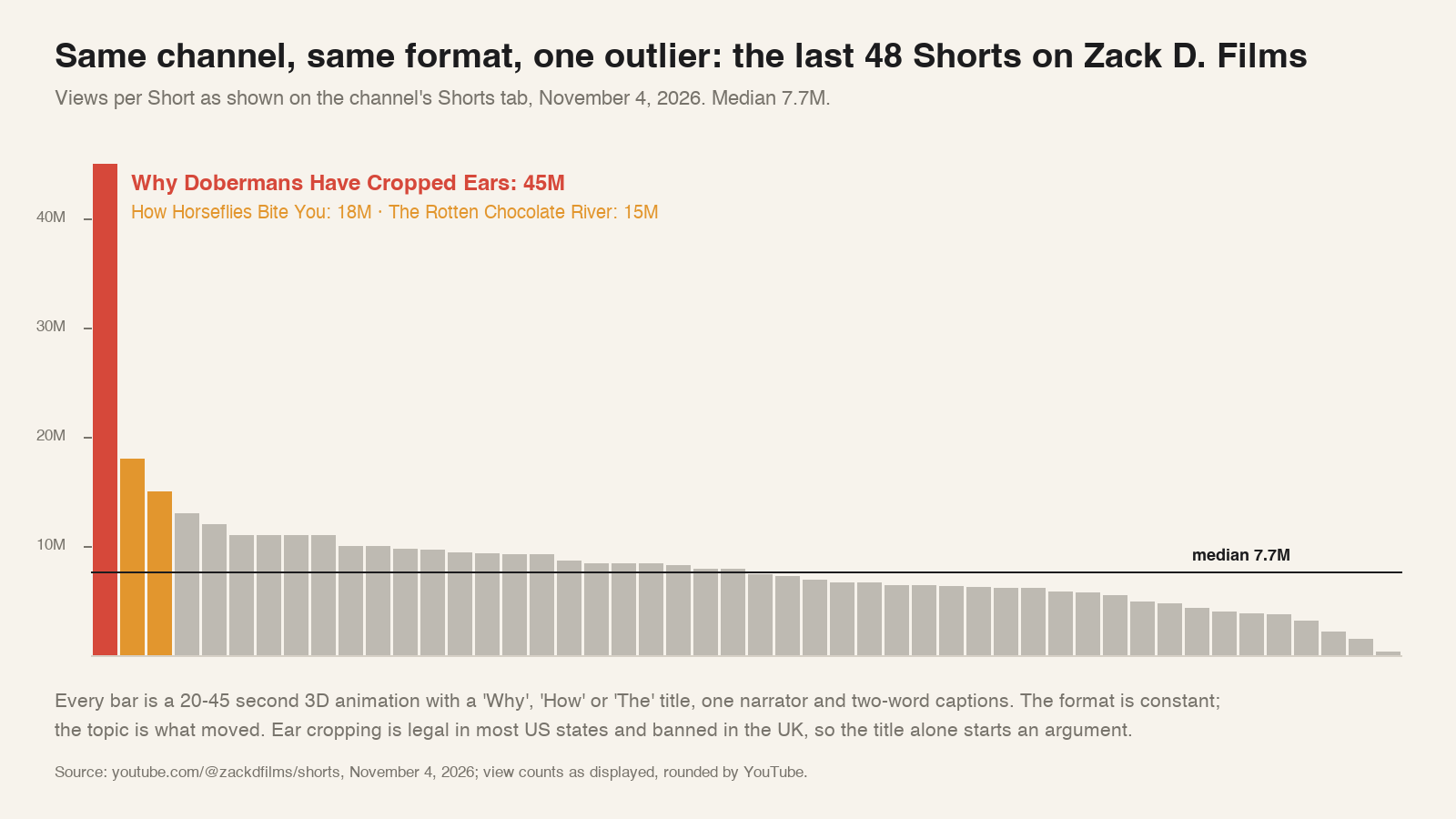
Here is the scale. Of the channel's last 48 Shorts, two others passed 15M ("How Horseflies Bite You" at 18M, "The Rotten Chocolate River In Willy Wonka" at 15M). The median is 7.7M. This one is six times that, on a channel that changes nothing between videos.
Why it went viral
Three reasons. The first one does most of the work.
People already argue about this. Ear cropping is cosmetic surgery on puppies. The American Kennel Club's breed standard describes cropped ears. The UK bans it. Several US states and most of Europe restrict it. Every few months a celebrity's Doberman photo sets the argument off again. So a "why" video about it gets watched by people on both sides, and then they fight in the comments. The 😞 in the title says which side the video takes. That is what makes the other side tap.
The first frame is the surgery. No "did you know". No shot of a cute dog. Frame one is a blue glove, a blade, and a floppy ear being cut to a point. The narration starts mid-thought: "Their floppy ears are cut into a point and taped to a stick so they heal upright." You expected a dog. You got a procedure. Hookova's classifier calls that a pattern interrupt, and that is exactly what it is. The whole dog shows up at 0:04, after you already have a question.
It's one long shot. Hookova runs scene detection to find hard cuts. On this video it found none. The 13 rows in the storyboard are Hookova pacing a single continuous animation: the 3D camera glides from the clinic to a guard yard to a living room, and the camera distance does what a cut would normally do. Close for the procedure. Medium for the dog. Wide for the world it lives in. Then back to a close-up at 0:16 when the blade comes back for the tail. Your thumb has no reason to move.
What Hookova found
| Metric | Value |
|---|---|
| Duration | 31.3 s |
| Storyboard rows | 13 (sub-frame pacing, 1.5 to 2.9 s each) |
| Hard cuts | 0 |
| Rows inside the first 3 s | 2 |
| Camera | Locked off in 13 of 13 rows; it moves between beats and holds inside each one |
| On-screen text | Two or three words per beat, in step with the voice |
| Hook type | Pattern interrupt 65%; bold claim 18% |
One note on the runner-up. The script's last line is a claim ("we're sort of just hurting these dogs for no reason"), and that line is what the comments fight over. But the hook is the blade at 0:00. The claim is the ending.
The first three seconds, shot by shot
| # | Time | What you see | What it's doing |
|---|---|---|---|
| 1-1 | 0.0–2.9 s | Extreme close-up: a gloved hand cutting a floppy ear to a point. Caption "are cut into a point". | Opens on the most shocking image in the video. You ask "what am I looking at", and the title already told you. |
| 1-2 | 2.9–4.4 s | Extreme close-up: the ear taped upright to a stick in white bandage. Caption "and taped to a stick". | Finishes the procedure with a prop few people have seen. "Taped to a stick" is the detail people repeat. |
| 1-3 | 4.4–6.9 s | Medium full shot: the whole Doberman, ears standing, on a lead next to a uniformed handler. Caption "so they heal upright". | The reveal. Those close-ups belonged to this dog, and the handler sets up the guard-dog history. |
Two rows in the first three seconds, both close-ups, both of the procedure. The opening shows the thing the title promised. The rest explains it.
The structure: thirteen beats, one camera move
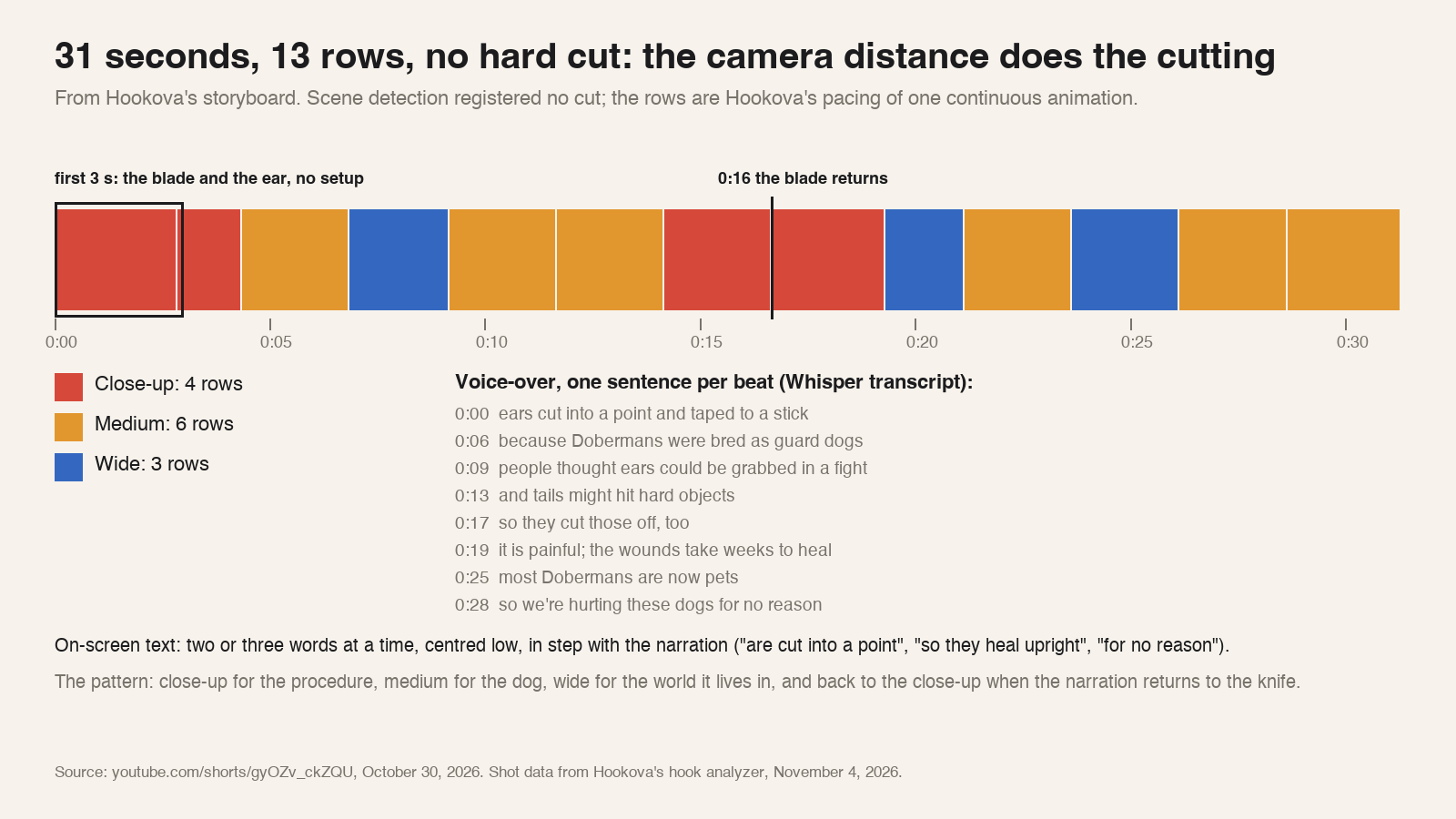
Eight sentences, and each one gets its own picture. The procedure (0:00–0:04). The guard-dog history, with a handler and a staged attacker grabbing at the ears (0:04–0:14). The tail hitting a door frame, then a second blade (0:14–0:19). A row of puppies on a table, to say this happens at scale (0:19–0:23). A living room with a kid and a tennis ball, to say these dogs are pets now (0:23–0:29). Last frame: two Dobermans side by side, one cropped, one natural, under "for no reason".
The move worth stealing is the blade at 0:16. The video opens on a cutting tool, leaves it for twelve seconds of history, then brings it back for the tail. That is why 31 seconds feels tight. You get the image you started with, and the turn ("but cutting off a dog's ears and tail is painful") lands right on it.
Transcript
The voice-over, from Hookova's Whisper transcript:
Their floppy ears are cut into a point and taped to a stick so they heal upright. Now, this is because Dobermans were once bred as guard dogs, and in a fight, people thought their ears could get grabbed and pulled. They also thought their long tails might hit hard objects and get broken. So they cut those off, too. But cutting off a dog's ears and tail is painful and the wounds take weeks to heal. And since most Dobermans are now just kept as pets, we're sort of just hurting these dogs for no reason.
75 words. The script skips "cropping", "docking" and "cosmetic". It says cut, taped, grabbed, pulled, broken, painful. Every verb is something you can picture, and every sentence is under fifteen words. That is why two-word captions can keep up.
What I'd actually copy from this
I run a lot of explainer Shorts through Hookova. The ones that look like this channel usually die in the same place: they open on a question and spend three seconds asking it. This video skips the question. The title asks it. The first frame answers the grossest part. The narration starts mid-sentence. That is the move, and it works for any "why X" video. Find the single most concrete image in your explanation and put it at 0:00. Before the dog, before the logo, before "so".
Second, the verbs. Cut, taped, grabbed, pulled, broken. The script sounds simple because the narrator picked the physical word every time. Physical words fit in two-word captions. "Cosmetic procedure" needs a full sentence, and the pacing dies.
Third, the mirror. Open on an image, bring it back once, about halfway, when the script turns. It costs nothing and it is what makes a 31-second video feel built.
What I would skip copying is the output. Several videos a day, all this clean, is a studio with a pipeline and a custom Blender setup. And the 46M video sits on top of 47 others that got the normal number. The topic made this one. The format made the channel.
How to use this pattern without copying the video
Hookova's rule: borrow the structure, never the content.
- Pick a topic people already fight about. The six-times result came from the subject. The other 47 Shorts show what this format does on a neutral one.
- Open on the most concrete image you have. No question, no establishing shot. The title asks, the first frame shows.
- Write in physical verbs. Under fifteen words a sentence, and a verb you could draw. Then cut each caption to two or three words that match the voice exactly.
- One sentence, one picture. Eight sentences here, thirteen rows, nothing held over three seconds.
- Let the camera distance do the cutting. Close for the procedure, medium for the subject, wide for the context. No hard cut in 31 seconds, and it keeps moving the whole way.
- Bring the opening image back once. Here it is the blade at 0:16. Put it where the script turns.
- End on the comparison. Two dogs, one line. The last frame is the one people screenshot and argue about.
Then paste your draft into Hookova and check two numbers against this page: rows inside the first three seconds, and the length of the longest row. Under two, or over three seconds, means your opening is doing setup the title already did.
FAQ
Why is Zack D. Films so popular? The channel posts the same product every day: a 20 to 45 second 3D animation, one narrator, a "Why" or "How" title, two-word captions, on topics gross or strange enough to repeat to a friend. The last 48 Shorts have a median of 7.7M views. That is the format working. The 46M Doberman video is the format on a topic people already argue about.
How does Zack D. Films make his animations? In 3D, with a team. The studio's job listings ask for 3D generalists to make 20 to 45 second clips and list Blender as a plus, and its head of animation has described a custom Blender add-on for reusing characters and sets. That reuse is why hundreds of videos look the same.
Is Zack D. Films AI? The animation is made by animators, going by the studio's own job postings, which hire 3D generalists and name Blender. We have seen no statement about the voice or the scripts, so this page makes no claim about those.
Why do Dobermans have cropped ears? The video's answer: Dobermans were bred as guard dogs, and people believed floppy ears could be grabbed in a fight and long tails could hit things and break, so both were cut. The ears are cut to a point and taped upright for weeks while they heal. Most Dobermans are pets now, which is the video's argument that the practice has no reason left. The procedure is banned in the UK and restricted in parts of the US.
Why does Hookova call the hook a pattern interrupt? Because frame one is a surgery, and you tapped a video about a dog. The classifier put pattern interrupt at 65% and bold claim at 18%. The bold claim is the last line of the script, which is what the comments argue about. The hook is the blade at 0:00.
Where does the data in this article come from? Views, likes and the subscriber count are from the public YouTube watch page on November 4, 2026. The view counts for the other 47 Shorts are from the channel's Shorts tab the same day, rounded the way YouTube shows them. The storyboard, timings, camera notes, hook type and transcript are from a Hookova analysis run on November 4 (job 84afe27d). Production details are from the studio's public job listings.
Want this kind of breakdown for a video you're studying? Analyze it with Hookova and get the storyboard, the hook type and the shot-by-shot notes in about two minutes.