 Hookova
TL;DR — The fairy meme is the AI-generated clip of two tiny, pale, wrinkly fairies on a mossy branch who whisper, gasp and collapse into giggles. The video we took apart is a 49-second compilation of five of those clips, posted on October 28 by @blssmflwer, an account with 346 followers and four videos, under a single line of on-screen text: "me and that one girl." Thirty-six hours later it had 518K views and 17.2K shares. Hookova's storyboard found 24 rows, two real scene changes, and no authored element at all beyond that caption. The clips belong to other accounts, and the second half of this breakdown is about tracing which ones.
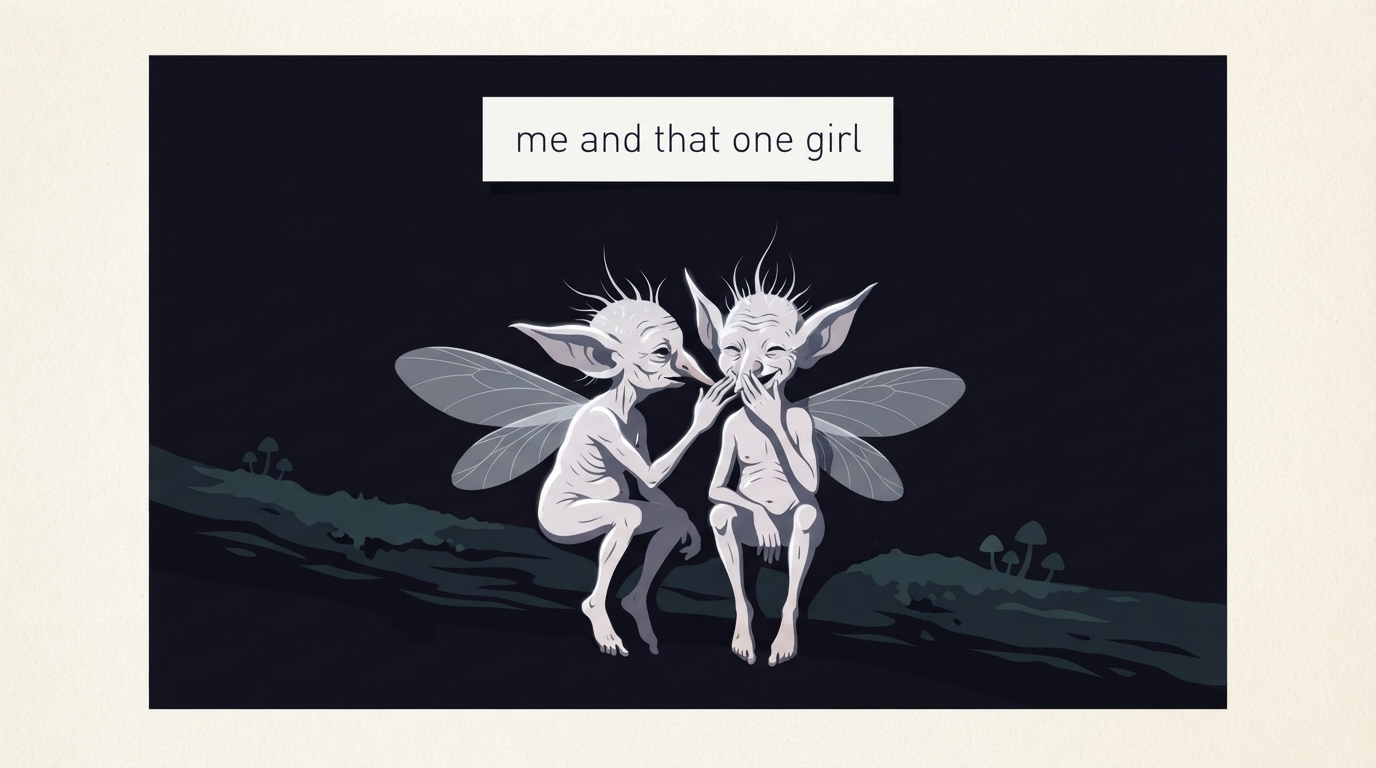
The video
- Creator: @blssmflwer — bio reads "spam acc"; 346 followers, 4 videos, 65K total likes, almost all of them from this post
- Posted: October 28, 2026, around midday UTC
- Caption: "🥹😭 || #viral #fyp #fairy #meme"
- On-screen text: "me and that one girl", present on every frame
- Length: 49.9 seconds · 24 storyboard rows · 2 main cuts · original sound · carries TikTok's AI-generated label
- Numbers at 36 hours: 518K views, 63.2K likes, 17.2K shares, 4,691 saves, 412 comments
Two of those numbers matter more than the view count. Shares run at 3.3% of views, which is high for TikTok, and comments are almost absent. People are sending this to one specific friend, and few of them stop to comment. That is the whole mechanism of the post, and the caption is what makes it work: "me and that one girl" turns a clip about two fairies into a clip about you and whoever you are about to tag.
Who actually made the fairies
This is the question a reader sent us along with the link, and it took some digging, because the same clips are posted by dozens of accounts. Here is what we could establish from public pages on October 29.
The characters come from Fae Nest (@fae.eyes). That account has 480K followers and 13M likes, describes itself as "Fae Nest Productions", links a Shopify store taking preorders for a "PRILILI Plushie", and runs a YouTube channel that released a Fae Nest "original soundtrack" on October 26. Its bio says "PRILILI Volume 2 Out Now". Trend-tracking sites date the first found-footage fairy posts to October 1, with the breakout clip, captioned "I really wish I knew what they were saying", around October 5 or 6 at roughly 8.5M views. Commenters spelled the fairies' babble as "prilili", and the creator adopted it as the main fairy's name. We could not open the account's video list without logging in, so the dates and that view count come from secondary sources; the follower count, the store and the soundtrack are from the account's own pages.
The specific clip that opens the compilation was posted by Piripiri & Prilli (@piripiriprilli) on October 22. We ran that 11-second post through Hookova as well, and its seven keyframes match the first 10.8 seconds of the compilation frame for frame: the whisper, the left fairy standing up with its wings spread, the laugh. Piripiri & Prilli is a Brazilian account with 200K followers and 102 videos, a Portuguese bio ("200K seres encantados"), playlists named "Novelas" and "Prilili", and a line claiming 41.2 million total views. Its version of the clip, captioned "not a single strand of hair was tossed", has 2.8M views, 533K likes and 156K shares.
What we could not settle is whether Piripiri & Prilli generated that clip or reposted one of Fae Nest's. The character design, the night-time branch, the flashlight look and the babble are Fae Nest's, and the Brazilian account's bio and playlist names place it inside the Prilili world that Fae Nest built. The honest answer for a creator who wants to credit someone is: the fairies are Fae Nest's; the clip you are watching may have passed through one or more other accounts on the way to you.
So the chain for this one video runs Fae Nest, then Piripiri & Prilli (2.8M), then @blssmflwer (518K), and each step added one thing: the characters, then a Portuguese-audience repost with its own caption, then an English caption built for sharing.
What Hookova found
| Metric | Compilation (@blssmflwer) | The 11-second clip (@piripiriprilli) |
|---|---|---|
| Duration | 49.9 s | 11 s |
| Storyboard rows | 24 (2 main cuts, 22 sub-frames) | 7 (1 main cut, 6 sub-frames) |
| Average row length | 6.1 s | 3.7 s |
| Camera | Locked off in 18 of 24 rows | Locked off throughout |
| Rows inside the first 3 s | 2 | 2 |
| Hook type (Hookova's classifier) | Skit / POV, 62% · runner-up Pattern interrupt, 15% | Visual, 79%, no runner-up |
The two classifications are the interesting part. The same opening footage reads as "Visual" on its own and as "Skit / POV" once the caption sits on it. Nothing changed in the picture. The line "me and that one girl" assigns the viewer a role in the scene, and the classifier picks that up as a point-of-view skit. That is a clean demonstration of how much work four words of on-screen text can do.
The first three seconds, shot by shot
| # | Time | What you see | What it's doing |
|---|---|---|---|
| 1-1 | 0.0–1.5 | Two pale, winged, long-eared creatures face each other on a mossy branch, lit hard from the front against black. Caption already on screen | The creature close-up is the stop. If you have seen the meme, you know what is coming; if you have not, you want to know what these are |
| 1-2 | 1.5–3.0 | The left fairy stands bolt upright, one arm raised, wings dropping to its feet | The first surprise. A static pair becomes a scene. Audio: "Betty Betty, the big time," which means nothing and sounds like it should |
| 1-3 | 3.0–5.2 | Both back to standing side by side, looking forward | The reset before the laugh. A pause that makes the next movement land harder |
There is no spoken hook, because there are no words. Hookova's transcript is phonetic babble from start to finish. What holds the first three seconds is a creature you cannot immediately explain, a sudden movement, and a caption that tells you the creature is you.
The structure: five clips, one caption
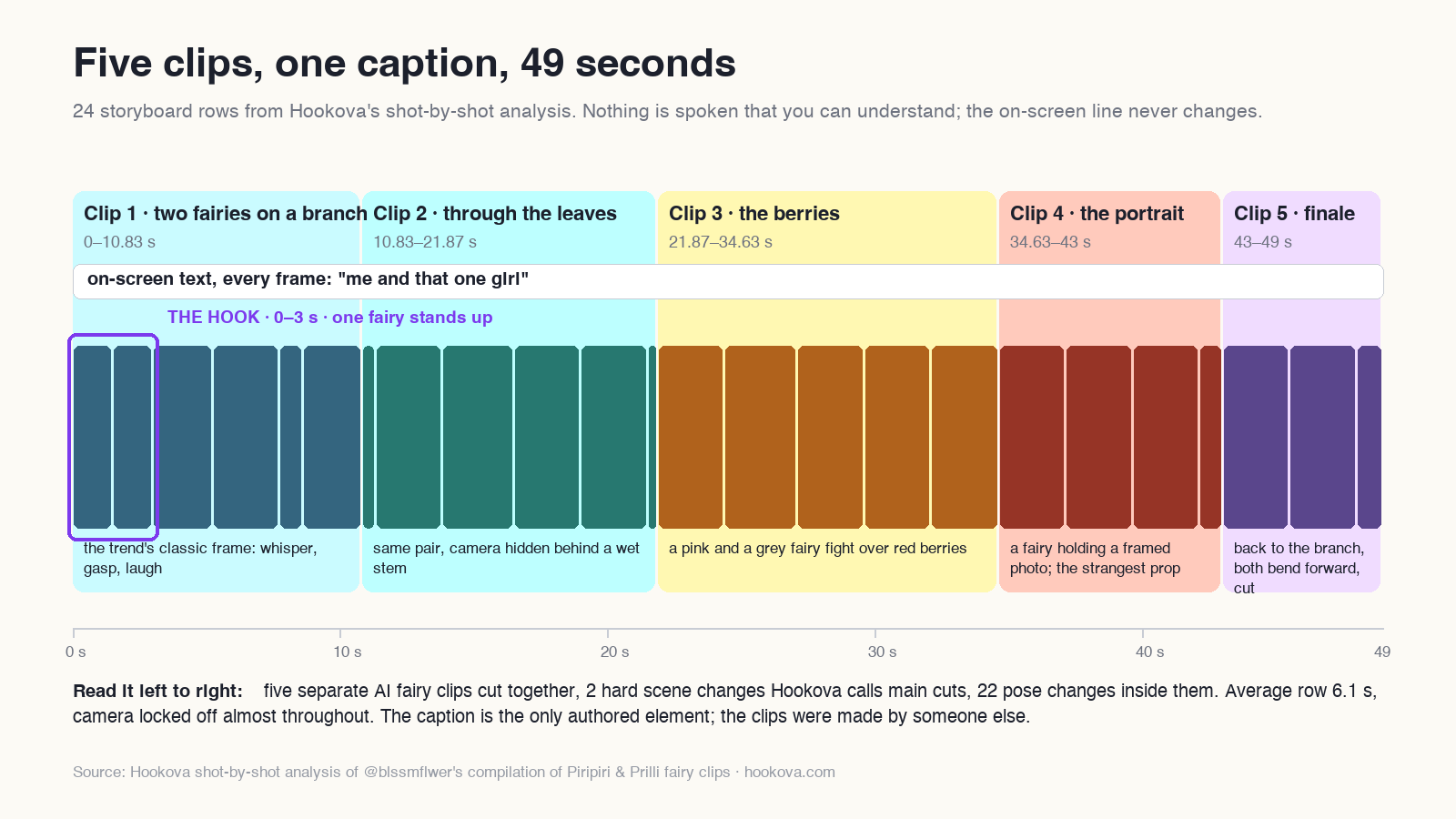
Hookova's storyboard splits the video into five scenes, each a separate AI clip:
- The branch (0–10.8 s). The Piripiri & Prilli clip, complete. Whisper, stand up, laugh, both throw their heads back, then a blurred lateral move. Audio: "Bluti fruti", then laughter.
- Through the leaves (10.8–21.9 s). The same pair, filmed from behind a wet stem that cuts the frame in half. One points, the other sinks lower, then lies flat. The obstruction is the only camera idea in the whole video, and it is a good one: you lean in to see past it.
- The berries (21.9–34.6 s). Two different fairies, one pink and one greyish green, bent over a cluster of red berries. Pointing, covering the mouth, lunging. The berries are the first color in a green-and-black video.
- The portrait (34.6–43 s). A pink fairy seated with a small framed photo, a taller grey one standing over it. The pink one tips backward with a round pale object at its mouth. This is the strangest footage in the compilation and the one row where Hookova's description visibly struggles to say what is happening.
- The finale (43–49 s). Back to a branch, two fairies in harsh white light, gazes lowered, then both bend sharply forward and the video ends mid-motion.
Between the five clips the compilation does nothing: no transitions, no text changes, no sound design. Each clip is simply the next one. Average row length is 6.1 seconds, which is slow for TikTok, and it works because the clips themselves are the attraction. Anyone opening this already likes the fairies; the compilation's offer is "five of them in a row, and a caption to send with."
Why it travels
Compare the two posts' share rates. The original 11-second clip: 156K shares on 2.8M views, about 5.6%. The compilation: 17.2K on 518K, about 3.3%. Both are far above what a typical TikTok gets, and both captions are the reason. "Not a single strand of hair was tossed" is an inside joke for people who have watched the fairies argue; "me and that one girl" is an instruction. You read it, a name comes to mind, you hit share.
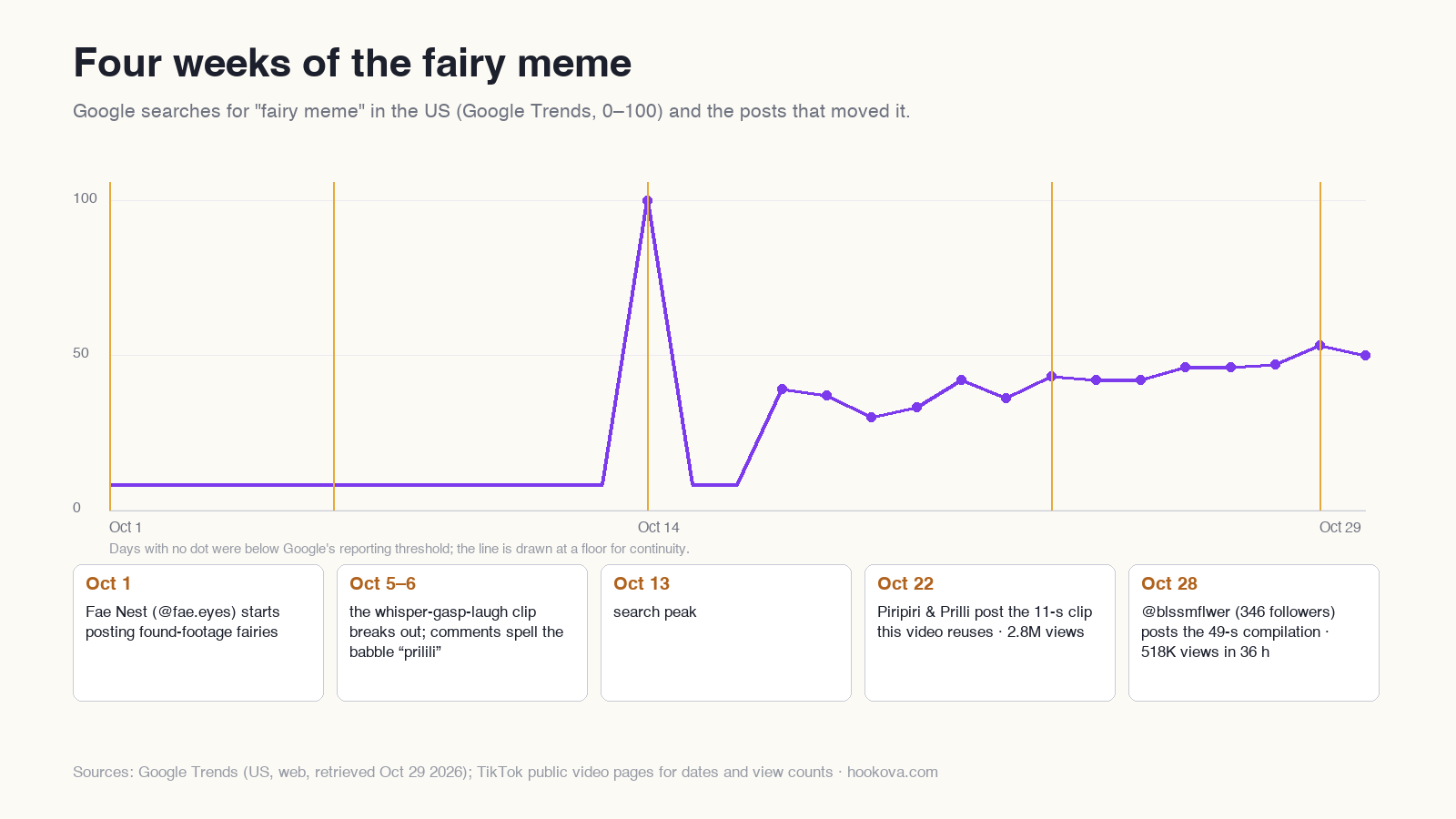
The trend is four weeks old and still live. US Google searches for "fairy meme" peaked on October 13 and have been climbing again since the 18th.
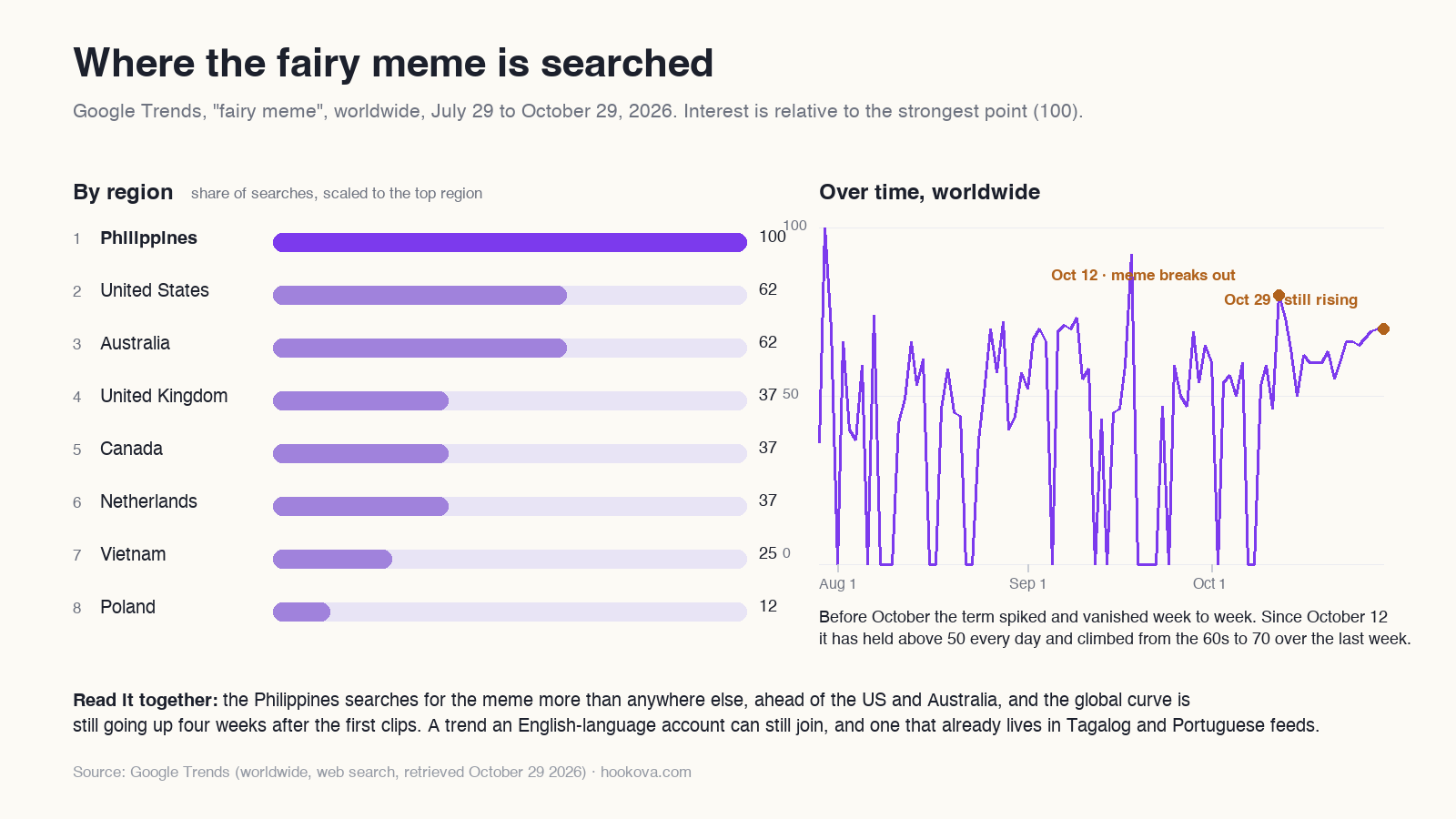
Zoom out to the whole world and the picture gets more interesting. Worldwide interest in "fairy meme" has stayed above half of its peak every day since October 12 and reached its highest level of the past month on October 28 and 29, so the curve is still rising while this video is being shared. And the country searching for it most is the Philippines, by a clear margin over the United States and Australia, with the United Kingdom, Canada and the Netherlands next. That fits what the clips are: wordless, so they cross languages, and built around gossip between two friends, a format that Filipino TikTok in particular runs on. For a creator thinking about which trend to join, a meme that is a month old, still climbing, and strongest outside the US is a rarer thing than it sounds.
TikTok's own search suggestions under the video are "fairy meme original video", "fairy meme templates" and "me and that one girl", which tells you what viewers do next: look for the source, look for a way to make their own, and look for the caption.
Transcript
Betty Betty, the big time. Bluti fruti. Hahahahaha! Ahhhhh! Hehehehehehe! One atom, cha-cha-chala, skulzi. Asko shiko sao mi, mi? Hah! Hehehehehehe! Asko shiko sao mi? Ahhhh! … Kiki trili, pipi pi, nya ka tili, tili. Brigi taka nili, nili, chikrili. Nyam! … Trili! Jhehehehehe! Hahaha! Trili, pipi, kikiki. … Nilili, trili li, nya ka. Ahhhh!
That is Hookova's transcription engine doing its best with sounds that were generated to resemble speech without being any language. The "prilili" spelling that gave the main fairy her name came from commenters doing the same thing by ear.
What I'd actually copy from this
I have watched this trend spread across my own feed for three weeks, and what strikes me about this particular post is how little the poster did. Five clips, one caption, no edit. The account has 346 followers. The result is more views than most of us get in a year.
The thing to take from it is the caption, and specifically the kind of caption. "Me and that one girl" is a relatability frame: it names a relationship the viewer has, and it lets the footage stand in for a feeling they recognize. The same five clips with "AI fairies compilation" on them would have done nothing. If you make content in any niche, you have footage that could carry a line like this, and the question to ask about each clip is which of your viewer's relationships it looks like from the outside.
The second thing is the share mechanic. Over 17,000 people sent this to someone. A post that gets sent to one friend is worth more to the algorithm than a post that gets a like, and the way to get sent is to make the viewer think of a person while they watch. That is a writing problem, and it is cheaper to solve than a filming problem.
What I would do differently is credit. The clips in this compilation are someone else's work, in the most literal sense: Fae Nest designed the characters and is now selling plushies of them, and Piripiri & Prilli's post is reproduced without a mention. A tag in the caption costs nothing and is the difference between a remix and a lift. If you want the pattern without the problem, make your own two characters, or use the fairies as a reference for your own generation and say so.
How to use this pattern without copying the video
Hookova's rule is pattern, never content. For this one that is unusually literal, because the content was lifted twice before it got here. Borrow the skeleton:
- One relationship caption, on every frame. Two or four words that name a person in the viewer's life. Write it before you choose the footage.
- Open on something that needs explaining. A creature, an object, an expression. The question "what is that" buys you the first second; the caption spends it.
- Movement at 1.5 seconds. A figure stands up, turns, or reaches. One motion, after a still opening.
- Let the clips run long. If the footage is the attraction, six-second rows are fine. Cutting faster would only hide what people came for.
- Stack by scene, in no particular order. Compilations hold attention by variety, so change the setting or the prop at each join.
- End mid-motion. The last row here cuts as both fairies bend forward. Unfinished movement is a cheap replay trigger.
- Credit the source. Tag the account whose footage or characters you are using. It is also how you end up in their comments, which is where the trend's audience actually is.
FAQ
What is the fairy meme? An AI-generated clip, styled like found footage, of two small pale fairies with big ears and thin wings on a mossy branch at night. One whispers, the other gasps, and both laugh in high-pitched babble that commenters transcribed as "prilili". It spread on TikTok through October 2026, with "me and my bestie" style captions, and is also called the laughing fairy meme, the gossip fairies, or Prilili.
Who created the fairy meme? The characters and the found-footage style are from the TikTok account Fae Nest (@fae.eyes), which started posting them at the beginning of October 2026 and is now selling a Prilili plushie and releasing fairy music. Many of the viral posts, including the one broken down here, reuse clips that passed through other accounts first; the 11-second clip that opens this compilation was posted by @piripiriprilli on October 22.
Why does Hookova call the hook a "Skit / POV" when nobody speaks? Because the on-screen caption "me and that one girl" casts the viewer as one of the two fairies. The same footage without the caption classified as a Visual hook at 79%. The words assign a role; the classifier reads the role.
Is the compilation account the original creator? No. @blssmflwer is a four-video account whose bio says "spam acc". It stitched five existing clips together and added the caption. The views are its own; the footage came from the accounts named above.
Where does the data in this article come from? From two Hookova shot-by-shot analyses, one of the compilation and one of the 11-second original clip (24 and 7 rows, one keyframe per row, Whisper transcripts), the public TikTok video and profile pages for both accounts and for Fae Nest, Google Trends, and trend-tracking sites for the early-October dates we could not verify directly, all retrieved October 29, 2026.
Want this breakdown for a video in your niche? Paste any TikTok, Reel or Short into Hookova and get the same storyboard in about two minutes. Your first three credits are free.