 Hookova
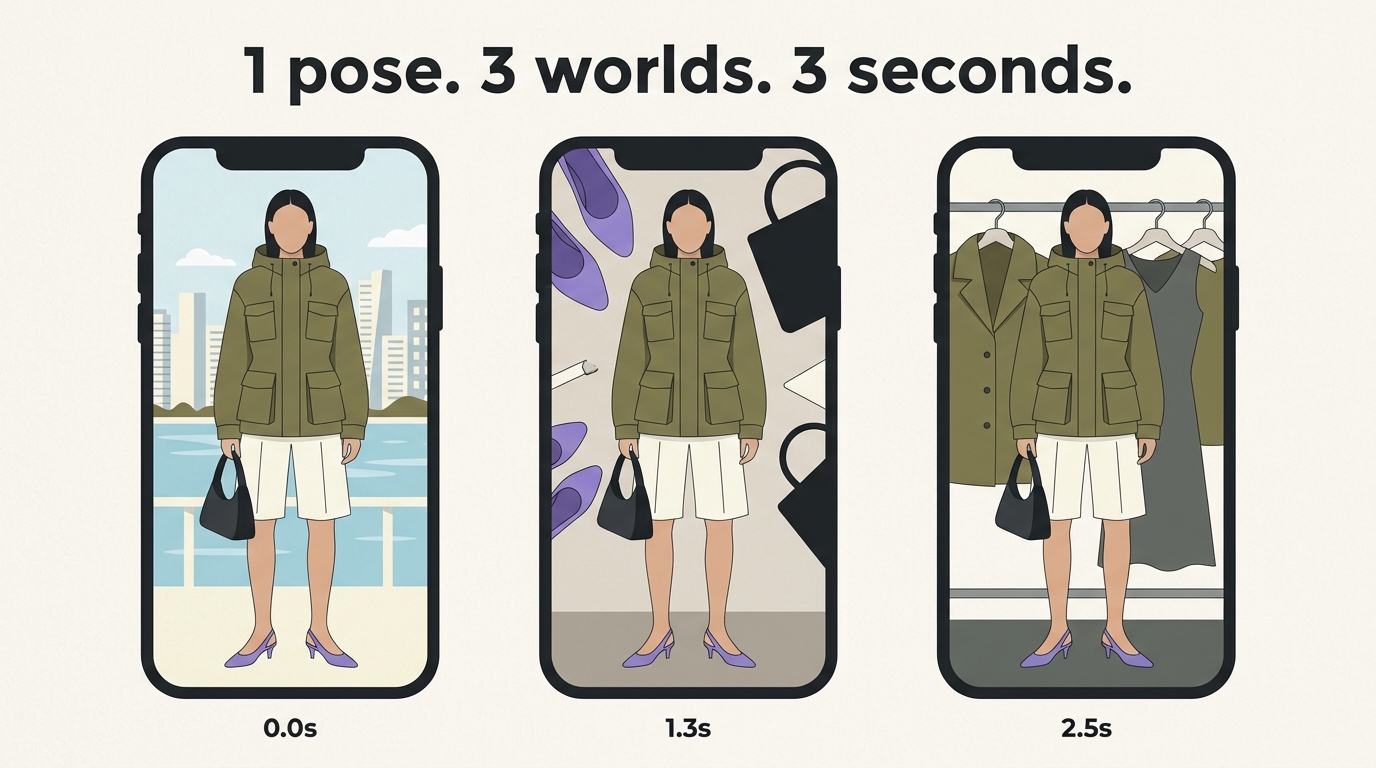
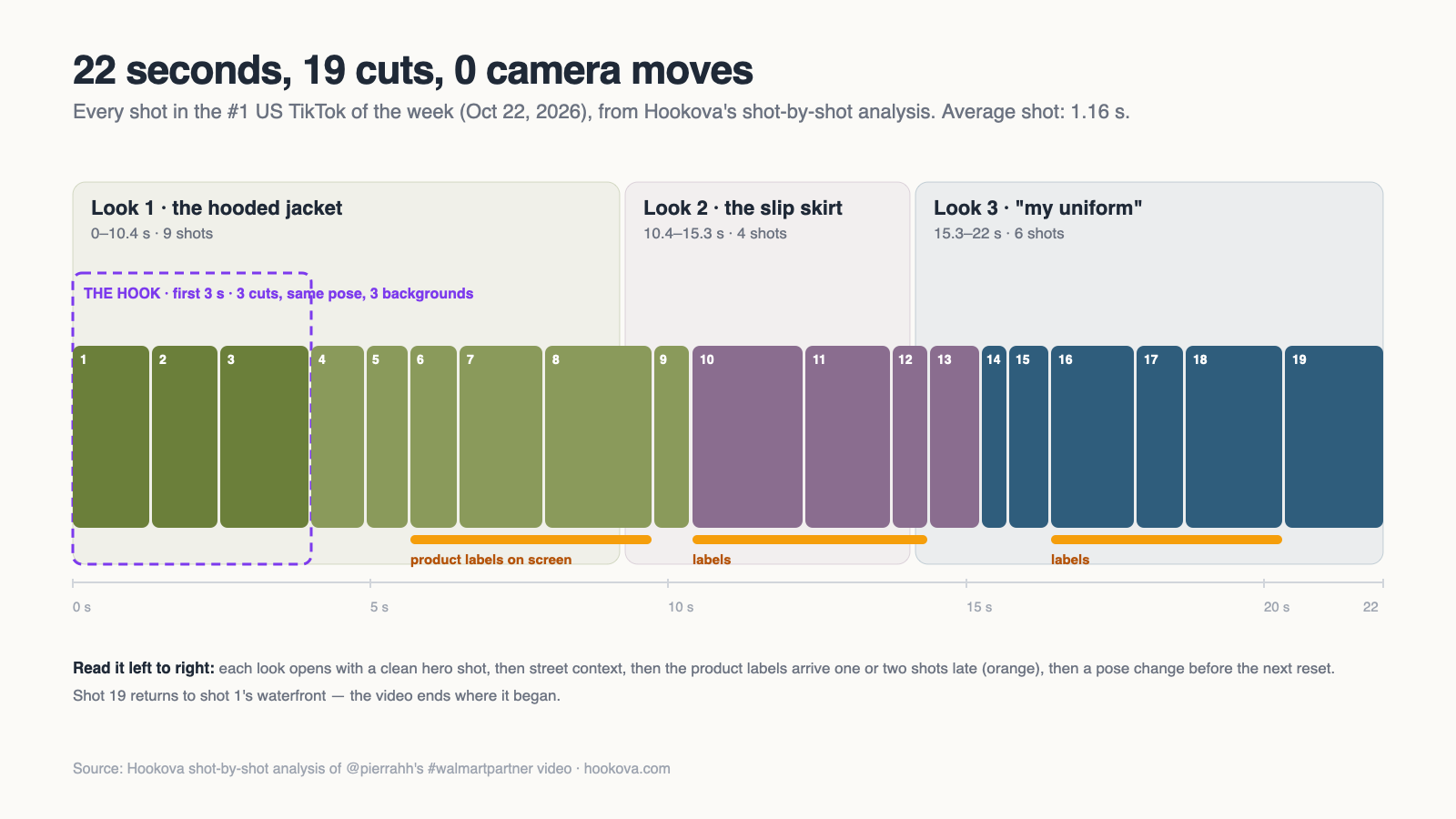
TL;DR — The most-viewed TikTok in the US this week is a Walmart fall outfits video. Not from a mega-creator: it's a 22-second sponsored edit from @pierrahh, an account with 74K followers, and it has 41M views (26M of them in the last seven days, per TikTok's own Creative Center ranking). We ran it through Hookova's shot-by-shot analyzer. The short version: there is no spoken hook to speak of. The first three seconds are three hard cuts of the same pose against three different worlds, and the entire video is built on a 1.16-second average shot length with the camera never once moving.
The video
- Creator: @pierrahh ("creative renaissance woman: creator & filmmaker"), 74.3K followers
- Posted: September 17, 2026, during New York Fashion Week
- Caption: "#walmartpartner runway silhouettes sourced at a cute price point. shop for your fall wardrobe…"
- Length: 22 seconds · 19 cuts · 0 camera moves
- Rank: #1 video by views, United States, last 7 days (TikTok Creative Center, Fashion)
One thing to say before anything else: this is a paid partnership, and a 74K-follower account does not reach 41M views on a sponsored post through the For You feed alone. The caption tag, the product labels and the view-to-follower ratio all point to Walmart running it as a Spark Ad — paid distribution behind an organic-looking post. That doesn't make the video less worth studying. It makes it more worth studying, because an ad that people don't swipe away has to clear a higher bar than a post they chose to watch. What follows is about the craft, not the media budget.
What Hookova found
Hookova breaks a video into shots, pulls one keyframe per shot, transcribes the audio and labels what each shot is doing. Here are the numbers for this one.
| Metric | Value |
|---|---|
| Duration | 22 s |
| Main cuts | 19 |
| Average shot length | 1.16 s |
| Camera movement | None — every shot is locked off |
| Shots inside the first 3 seconds | 3 |
| Hook type (Hookova's classifier) | Bold claim (28%) — runner-ups: Showcase (23%), Visual (21%) |
That hook classification is the first interesting thing. Hookova's classifier is usually confident; here it couldn't decide, and the three candidates it split between tell you why. The words in the first line are a bold claim ("who knew I could source this complete fall edit from Walmart"), but the claim lands at second 4, after the viewer has already been held by something else. What holds them is footage, not speech. When the classifier splits between a spoken technique and "Visual", the honest reading is: the hook is visual, and the line is there to give the visual a reason.
The first three seconds, shot by shot
| # | Time | Shot | What you see | What it's doing |
|---|---|---|---|---|
| 1 | 0.00–1.33 | Full body, static | Model posed in an olive hooded jacket, white bermuda shorts, purple heels, black bag — against a waterfront skyline | A striking silhouette in an unexpected place. Pure visual curiosity; no text, no claim yet |
| 2 | 1.33–2.47 | Full body, static | Same model, same pose, now composited over an overhead product-shot surface with oversized versions of her own shoe and bag | The world changes, she doesn't. A hard cut that rewards the viewer with a surreal transition instead of asking them to wait for one |
| 3 | 2.47–4.00 | Full body, static | Same pose again, now in front of enlarged garments on hangers | The giant clothes are a tease: there's a whole edit coming, not one outfit |
Three cuts, one pose, three backgrounds. Nobody says anything that matters until the third cut is almost over, and it doesn't matter, because the eye has already been moved three times. This is the pattern-interrupt version of a fashion hook: instead of "wait for it", the video does the thing three times before you've decided whether to stay.
The spoken line that runs under all three shots — the runway-silhouette setup and the Walmart reveal — is doing a second job. It's a curiosity gap for a specific audience. If you follow fashion, "runway silhouette" and "Walmart" don't belong in the same sentence, and the sentence is built so the brand name is the last word you hear.
The structure after the hook
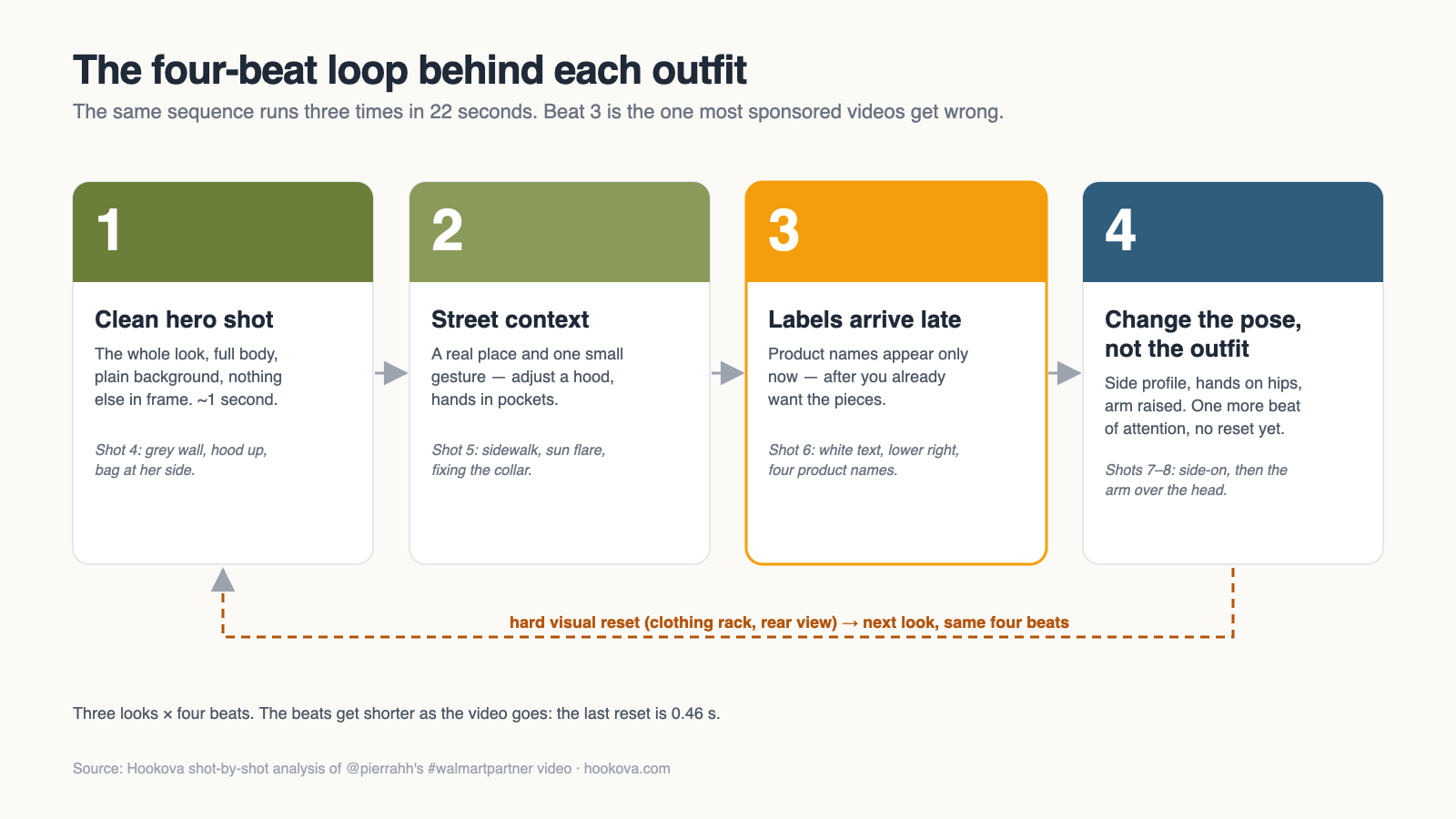
The remaining 18 seconds are three outfits, and each one follows the same four-beat loop:
- Clean hero shot of the look (shot 4: plain grey wall, nothing else in frame)
- Street context — a real sidewalk, a crosswalk, a café door — with one small gesture (adjusting a hood, hands in pockets)
- Product labels appear, white text, lower right, listing every piece by its Walmart product name — and only after the look has been established in shots 1–2
- A pose change, not an outfit change, to hold attention one more beat before the reset (side profile, hands on hips, arm raised)
Then a hard visual reset — the clothing rack, a rear view — and the loop starts over with the next look. Three looks × four beats, with the beats getting shorter as the video goes (the last look's rack transition is 0.46 seconds).
Two details Hookova's storyboard surfaced that are easy to miss watching at speed:
- The labels never arrive with the look. In all three outfits, the product text shows up one or two shots in. The viewer is given a reason to want the pieces before being told what they are. That ordering is the whole difference between an ad people watch and an ad people skip.
- The last shot is the first shot's location. Shot 19 returns to the waterfront from shot 1, in the third outfit, on the closing line. It's a bookend, and on TikTok a bookend is also a loop: the end looks like the beginning, so a rewatch doesn't feel like a restart.
Every piece in the video, by Walmart line
Hookova captures on-screen text per shot, so here is the full list of what the labels name — useful if you came here from a search for Scoop or Free Assembly pieces rather than for the editing. Three looks, three Walmart house lines (Scoop, Free Assembly, No Boundaries) plus two outside brands.
| Look | Pieces named on screen |
|---|---|
| 1 — the hooded jacket (shots 6–8) | Free Assembly Cinched Utility Jacket · Scoop Flowy Volume Cotton Blouse · Dressy Casual Bermuda Shorts with Pockets · Scoop Kitten Heel Mules |
| 2 — the slip skirt (shots 10–12) | Vanity Fair Radiant Half Slip · Forever 21 Grey Cozy Chic Relaxed Sweater · Madden Girl Charlotte Thong Kitten Heel with Bow |
| 3 — "my uniform" (shots 16–18) | Scoop Notched Hourglass Blazer · Free Assembly Argyle V-Neck Sweater Vest · Scoop The York Baby Tee · No Boundaries Low Rise Cotton Baggy Jeans · Free Assembly Women's Loafer |
Worth noticing for anyone planning Walmart fashion content this fall: the labels are product names, not prices. "Cute price point" is in the caption, and the video never says a number. The value claim is carried entirely by the word Walmart against the word runway.
Transcript
You know I love a runway silhouette, and who knew I could source this complete fall edit from Walmart. Now that it's fashion month, I'll be running around to shows and events, and this particular look is what I would wear sitting front row. The next look is very flirty. I would wear this to a dinner, and I especially love this slip skirt. The last look is my uniform. Most days, I'm wearing jeans and a blazer. Who knew I could source all of these elevated pieces at Walmart?
Eight lines, 22 seconds, and the first and last are the same sentence. Everything in between is a when-I'd-wear-it, not a what-it-is — the product names are left entirely to the on-screen text.
What I'd actually copy from this
I've watched a lot of outfit videos go nowhere, and the ones that go nowhere almost always make the same mistake this one avoids: they open on the creator talking. This video opens on a silhouette and lets the first sentence play as a voiceover. If I had to name the one decision that carried 41 million views, it's that the creator never appears as a person introducing a video. She appears as an image, three times, and only then as a voice.
The second thing is the shot length. 1.16 seconds on average, and never a camera move. That's a photographer's instinct, not a videographer's — every shot is a finished still, and the video is a slideshow that happens to be cut fast enough to feel like motion. For anyone without a crew, this is the most reproducible thing here: you can shoot every one of these frames on a phone on a tripod. The expensive-looking part is the compositing in shots 2, 3 and 14, and even that is a cutout over a still background.
What I wouldn't copy: the label density. Five lines of product text in the lower right (shot 16) is what a brand brief asks for, and it reads as a brief. If this weren't sponsored, I'd put one label per look and let the comments do the rest.
How to use this pattern without copying the video
Hookova's rule — and ours — is pattern, never content. Don't reuse the footage, the lines, or the on-screen text. Borrow the skeleton:
- Open on a still, not a face. Your strongest full-body frame, in a location that doesn't match the subject. Hold it for about a second.
- Cut the world, not the subject, twice, inside the first three seconds. Same pose, different background. If you can't composite, change the real location.
- Say the premise as voiceover over those three cuts, and put the surprising word last.
- Introduce the details one beat late. Show the thing, show it in use, then label it.
- Change the pose before you change the subject. It buys a beat without a reset.
- End where you started. Same location, final state, closing line.
Three opening lines built on the same skeleton, for three different niches — written here, not borrowed:
- Home / DIY: "This whole corner cost less than the lamp did — and the lamp was from [store]." (bold claim, surprising word last)
- Food: "Three dinners from one grocery run, and I didn't go to the fancy place." (list + callout)
- Fitness: "Same workout, three locations, and only one of them had equipment." (challenge framing, matches the three-worlds visual)
FAQ
Is this video organic or an ad? It's tagged #walmartpartner, which is a paid partnership. The view count relative to the account's 74K followers strongly suggests paid amplification (a Spark Ad). The craft analysis above applies either way; the view count shouldn't be read as a purely organic result.
What hook technique does it use? Hookova's classifier split between Bold claim, Showcase and Visual, which in practice means the hook is carried by the footage — three hard cuts of one pose in three settings — with a bold-claim voiceover underneath.
How many shots are in the first three seconds? Three, each about 1.1–1.5 seconds, all static full-body frames of the same pose.
Can I make something like this without editing software? The individual frames, yes — every one is a static, eye-level, full-body phone shot. The composited backgrounds in three of the shots need a cutout tool, but the structure works with three real locations instead.
Which Walmart brands are in the video? Scoop and Free Assembly make up most of the three looks, with one No Boundaries piece (the baggy jeans) and two non-Walmart items (a Vanity Fair slip and a Forever 21 sweater). The full list by look is in the table above.
Where does the data in this article come from? From a Hookova shot-by-shot analysis of the public video (19 rows, one keyframe per shot, Whisper transcript), plus TikTok's Creative Center ranking for the United States, last 7 days, retrieved October 22, 2026.
Want this breakdown for a video in your niche? Paste any TikTok, Reel or Short into Hookova and get the same storyboard in about two minutes. Your first three credits are free.