 Hookova
TL;DR — The strongest organic YouTube Short we could find this week is a Minecraft meme edit. SteveKong took the viral "who told you you could fish here — it's the road, dude" audio, rebuilt the scene inside a blocky game world, and then spent the second half of the video showing how. 45 seconds, 2.45M views in five days. Hookova's analysis splits it cleanly in two: an 18.5-second composite that is one shot with no cuts, and a 26-second "Behind the Scenes" that cuts every two seconds and adds exactly one layer per cut. The hook is the first cut — a real man in a real truck becomes a blocky man in a blocky boat at 1.5 seconds.
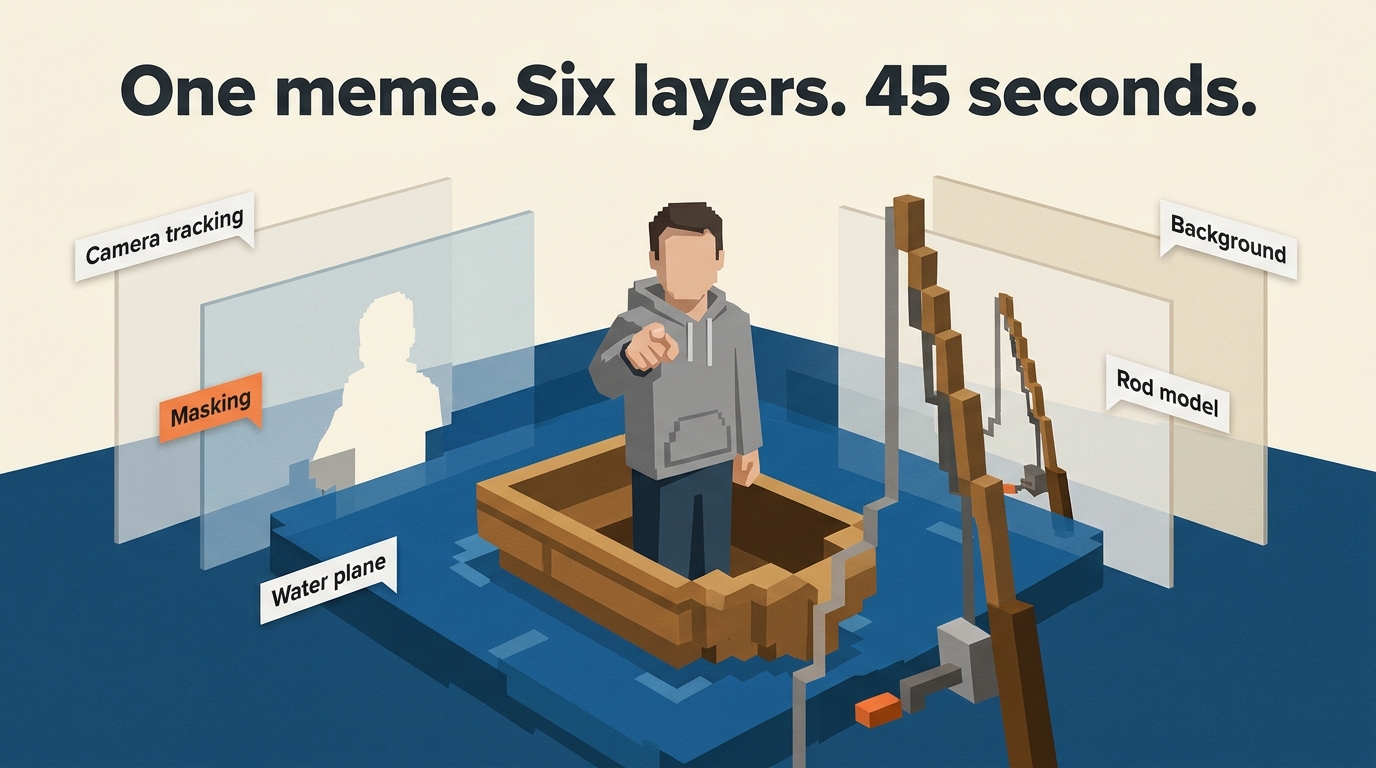
The video
- Creator: SteveKong — a meme-edit channel ("Software I used: DaVinci Resolve Studio, Vegas 21, Mocha"), under 100K subscribers
- Posted: October 17, 2026
- Title: "Editing Memes Is a Lost Art…"
- Length: 44.8 seconds · 22 storyboard rows · 0 camera moves · 1 cut in the first 18 seconds
- Views: 2.45M in five days
- The meme: the "private property" fishing clip — a man in a pickup telling a fisherman the lake is private, the fisherman insisting it's state land, the man answering "it's the road, dude." The original audio plays untouched; only the picture is rebuilt.
A note on how we picked it: YouTube has no public Shorts chart (Trending was retired in 2025), so we searched thirty broad topics with "uploaded this week, sorted by views" and kept only true Shorts. The rows above this one were a supermarket ad, a bank promotion and TV-show teasers. This is the top creator video — and it is not a sponsored post.
What Hookova found
| Metric | Value |
|---|---|
| Duration | 44.8 s |
| Storyboard rows | 22 (4 main cuts, 18 sub-frames) |
| Cuts in the first 18.5 s | 0 — one composite shot, nine beats |
| Cuts in the last 26 s | 13 — average 2.0 s |
| Camera movement | None |
| Hook type (Hookova's classifier) | Skit / POV, 81% confidence, no runner-up |
Two numbers tell the story. The classifier is unusually sure — 81%, no alternative — because the opening is a textbook POV skit: you are the fisherman, and a stranger is pointing at you. And the cut count: the first half never cuts, the second half cuts every two seconds. The video changes rhythm exactly once, at the "Behind the Scenes" title card, and that change is the retention device.
The first three seconds, shot by shot
| # | Time | What you see | What it's doing |
|---|---|---|---|
| 1a | 0.0–1.5 | A bald man leaning out of a white pickup window, real footage, looking at camera | Live action. Nothing says "game" yet. The audio starts: "crew tractor, oh crew tractor" |
| 1b | 1.5–3.0 | The same man, same pose, now standing in a blocky wooden boat on blocky water; a huge pixelated fishing rod fills the right foreground | The hook. The world changes and he doesn't. If you know the meme, you know the audio; the picture is the surprise |
| 1c | 3.0–5.5 | He points straight at the viewer across the water. Audio: "Who told you to fish here?" | POV locks in. The question is to you |
The pattern is the same one we saw in the week's top TikTok (the Walmart fall edit): hold the subject, cut the world. There it was a fashion pose against three backgrounds; here it is one man moved from a truck into a video game. One hard cut, one changed world, and the viewer's brain has a question it did not have a second ago.
The structure: two halves that do opposite things
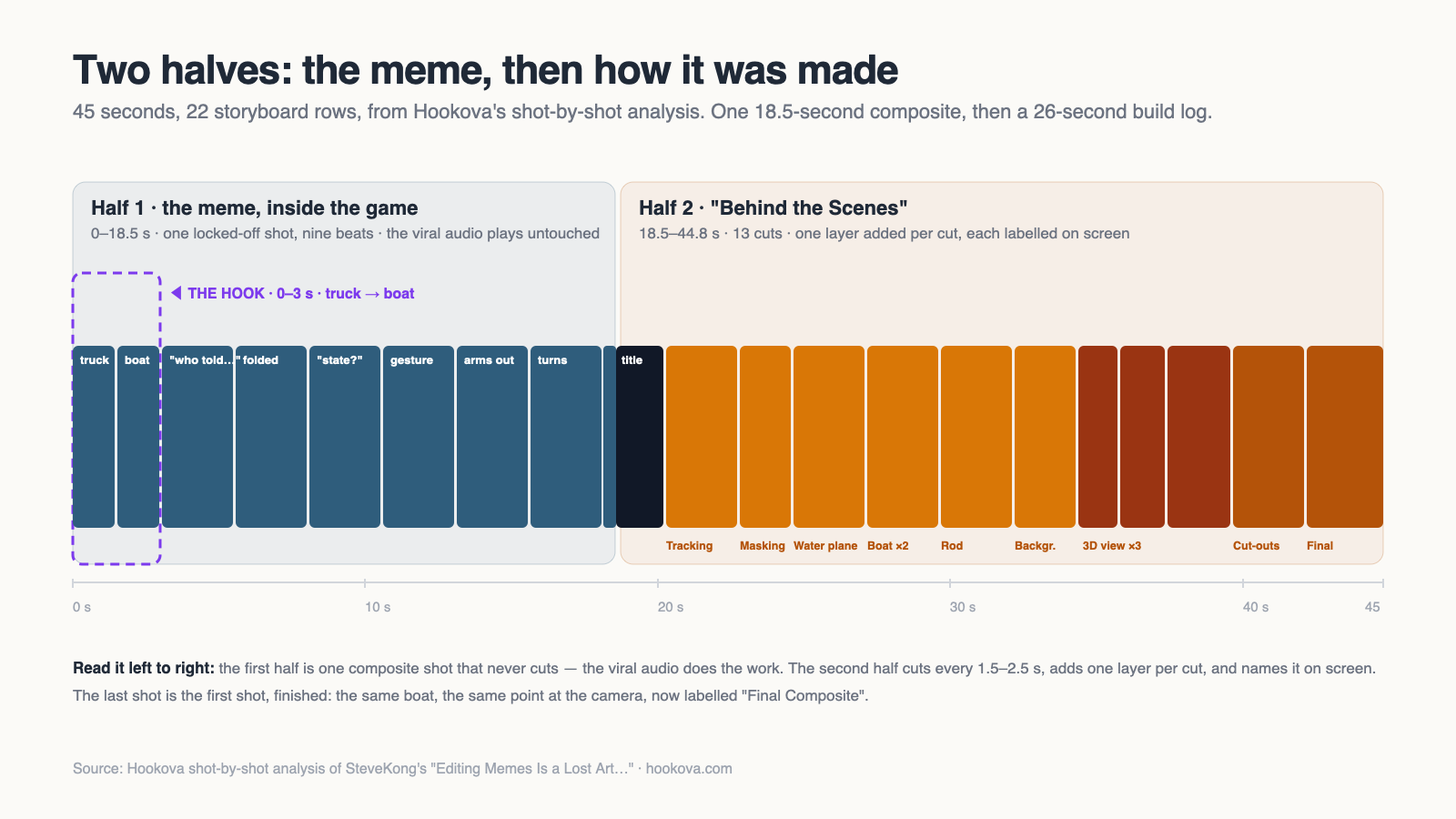
Half one (0–18.5 s): the meme, inside the game. One composite shot. Hookova breaks it into nine beats, but every one of them is the same frame — the boat, the rod, the man — with only his gesture changing: arms folded, leaning forward, turning sideways, both arms out, turning back, looking down. The audio does all the work; the picture is a static stage for it. There is no on-screen text at all.
The title card (18.5–20.3 s): "Behind the Scenes." Black screen, white pixel letters, a red underline. It is the only moment of nothing in the video, and it is doing a job: it tells the viewer who stayed through the joke that there is a second video, and that it is about how.
Half two (20.3–44.8 s): the build log. Thirteen cuts, one layer per cut, each one labelled in the same white pixel type:
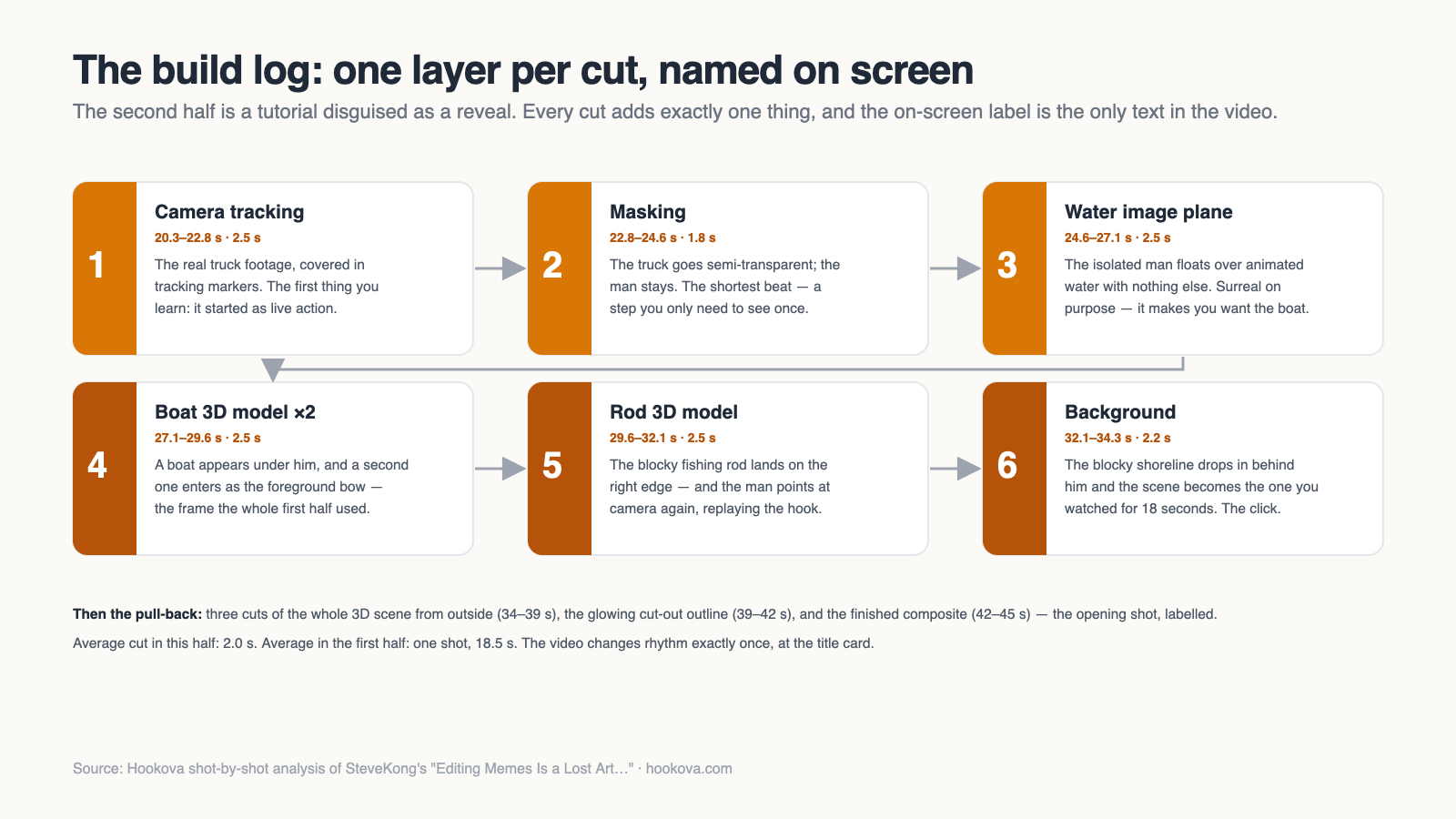
- Camera Tracking — the real truck footage, covered in tracking markers. The reveal that it started as live action.
- Masking — the truck turns semi-transparent; the man stays. 1.8 seconds, the shortest beat.
- Water Image Plane — the isolated man floating over animated water, nothing else. Deliberately incomplete.
- Boat 3D Model ×2 — a boat under him, and a second boat sliding in as the foreground bow.
- Rod 3D Model — the blocky rod lands on the right edge, and he points at camera again: the hook, replayed.
- MC Background — the shoreline drops in and the scene becomes the one you watched for 18 seconds.
Then three cuts pulling back to the whole 3D scene from outside (34–39 s), a glowing white outline around the cut-out actor (39–42 s), and the finished composite (42–45 s), labelled "Final Composite." The last shot is the first shot, finished.
What Hookova's storyboard made obvious that is easy to miss at speed: the build log is a tutorial with no words. Nobody explains anything. Six nouns on screen, in the order a compositor would actually do the work, each held for exactly as long as it takes to see the change. It respects the viewer enough to assume they can read a label and watch a layer appear.
Transcript
Crew tractor. Oh crew tractor. Yeah. Who told you to fish here? I thought it was state property. State? Yeah. This? Yeah. State? It ain't. It's the road, dude. This ain't no state property. This is private property. Oh, okay. What is your name? … Yeah, who told you to fish here?
Everything spoken belongs to the original meme clip; the edit adds no voice of its own. The only authored words in 45 seconds are the nine on-screen labels in the second half.
What I'd actually copy from this
The thing I keep coming back to is that this video is 45 seconds long and the first 18 of them have no cut. Every piece of advice about Shorts says cut faster. This one holds a single frame for longer than most Shorts last, and 2.4 million people watched it — because the frame is a joke, the audio is a joke everyone already knows, and holding still is what lets the joke land. The lesson isn't "don't cut." It's that cut rate should follow the content: a punchline wants stillness, a process wants rhythm, and this video gives each half the rhythm it needs.
The second thing is the build log, and I'd copy it in a heartbeat for anything with a process behind it — a recipe, a room makeover, a thumbnail, a set build. The format is: show the finished thing first, as entertainment, with no hint of the work. Then a title card. Then the work, one step per cut, one noun per step, no narration. It turns the viewer's "wait, how?" into the second half of the same video instead of a comment you have to answer.
What I wouldn't copy: the dependency on a meme everyone already knows. Strip the audio out and the first half is a man gesturing in a boat. For a creator without a viral soundbite to borrow, the structure still works, but the first half needs its own hook line — which is exactly what the Hook Generator is for.
How to use this pattern without copying the video
Hookova's rule — pattern, never content — matters more than usual here, because the video is itself a remix. Don't reuse the audio, the meme, or the labels. Borrow the skeleton:
- Open on the real thing for one second, then swap the world. Same subject, same pose, new environment. The cut at 1.5 s is the whole hook.
- Make the viewer the other person in the scene. A finger pointed at the lens and a question aimed at "you" is the POV skit in its simplest form.
- If the first half is a joke, don't cut it. Let the gesture changes carry it. One shot, several beats.
- Change rhythm once, on purpose, with a card. "Behind the scenes," "how," "part 2" — a two-second title card is the cheapest reset there is.
- One layer per cut, one noun per layer. Label it, hold it two seconds, add the next. Order the steps the way the work is actually done.
- End on the opening shot, finished. The last frame should be the first frame with a label on it.
Three opening lines built on the same skeleton, for three niches — written here, not borrowed:
- Cooking: [Cut from a real kitchen to a cardboard-cutout kitchen] "Who said you could use my pan?" — the POV accusation, with the swap as the hook.
- DIY / room makeover: [Cut from the empty room to the finished room, same angle] "You're standing in the wrong room." — then the build log, one layer (paint, rug, shelf, lamp) per cut.
- Thumbnail design: [Cut from a plain photo to the finished thumbnail, same framing] "This took six layers. Here's all of them." — the build log is the video.
FAQ
What is the "private property" fishing meme? A short clip of a man in a pickup telling a fisherman he can't fish there, the fisherman insisting it's state property, and the man answering "it's the road, dude — this is private property." It circulated as a soundbite in 2026; this Short recreates the scene inside a Minecraft-style world with the original audio.
Why does Hookova call the hook a "Skit / POV"? Because the opening drops the viewer into an acted scene as a participant: the man points at the lens and asks "who told you to fish here?" The classifier gave this 81% with no runner-up — the audio and the pointing gesture make it unambiguous.
How was the video made? The creator says DaVinci Resolve Studio, Vegas 21 and Mocha. The second half shows the order: camera tracking on the real footage, masking the man out of the truck, a water plane, two boat models, a rod model, the background, then cut-out cleanup and the final composite.
Is it really the top Short of the week? It is the top organic creator Short our method found. YouTube has no public Shorts ranking, so we searched thirty broad topics with "this week, sorted by views" and kept only true Shorts; the rows above this one were ads and TV promos. A Short with more views that none of those queries reached would not appear.
Where does the data in this article come from? From a Hookova shot-by-shot analysis of the public video (22 rows, one keyframe per row, Whisper transcript), plus YouTube's own search results and video details, retrieved October 22, 2026.
Want this breakdown for a video in your niche? Paste any TikTok, Reel or Short into Hookova and get the same storyboard in about two minutes. Your first three credits are free.