You saw a video where a face fills the whole frame, the room curves away behind it, and the shot feels like it is leaning into you. So you searched for a fisheye lens and found a $40 clip-on with a hundred reviews complaining that the corners come out soft.
Most of those product pages leave out the part that matters. The effect you are chasing comes mostly from how close the camera is, and the phone in your hand already has a lens wide enough to produce it. A comedy creator shooting a punchline, someone filming a skate line, a freelancer who needs a product to look enormous in the first frame — same shot, three jobs, and two of them need to buy nothing at all.
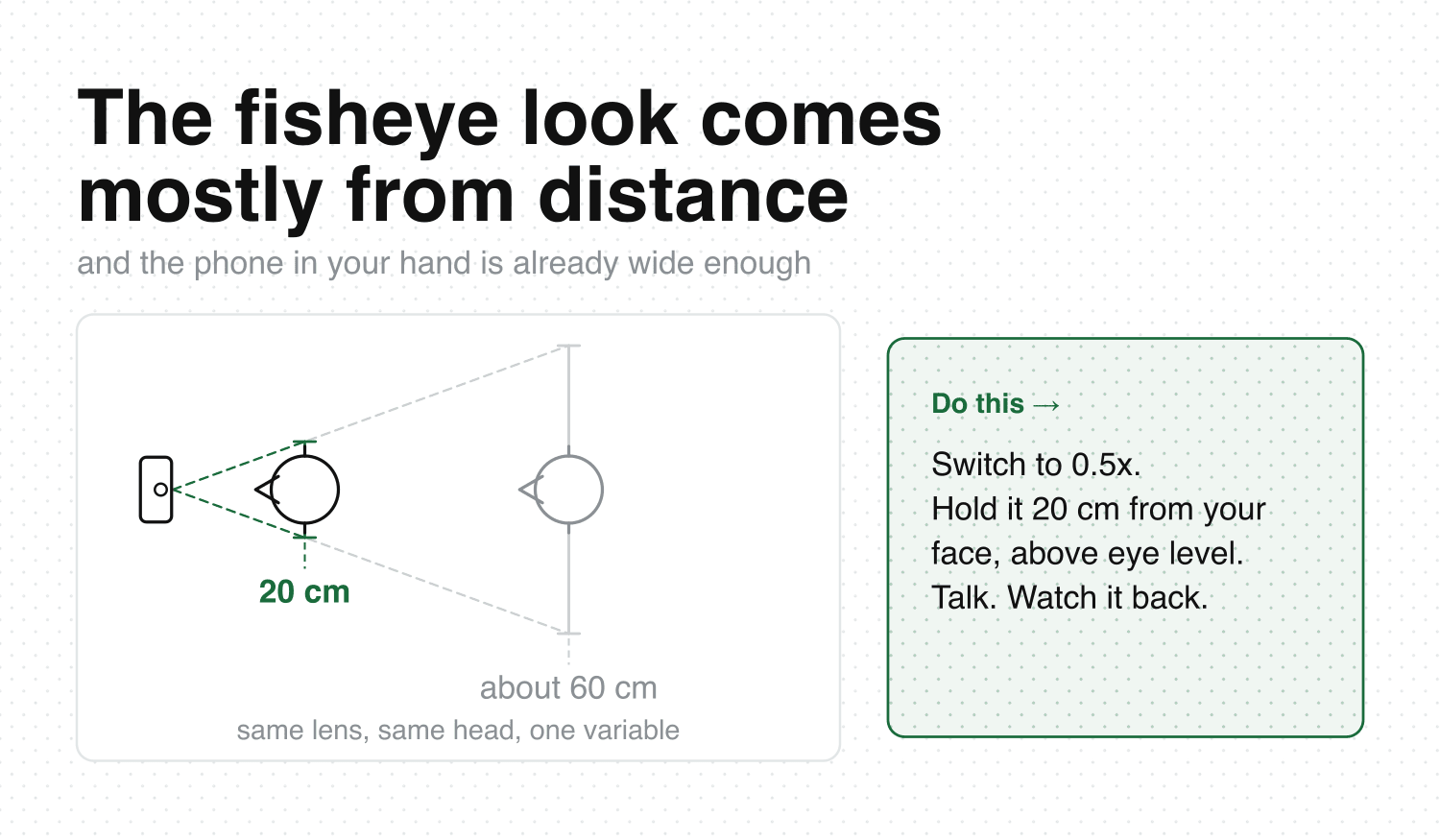
Switch your camera to 0.5x. Hold it about 20 centimetres from your face, slightly above eye level, and talk. Watch it back.
That is most of the look. If it is what you wanted, go shoot.
Here is the thing every gear review skips. Perspective distortion — the way a nose looms and a back wall falls away — is set by camera-to-subject distance. It is not a property of the lens. Shoot a face from three metres on a fisheye and it looks normal, just with a lot of room in shot.
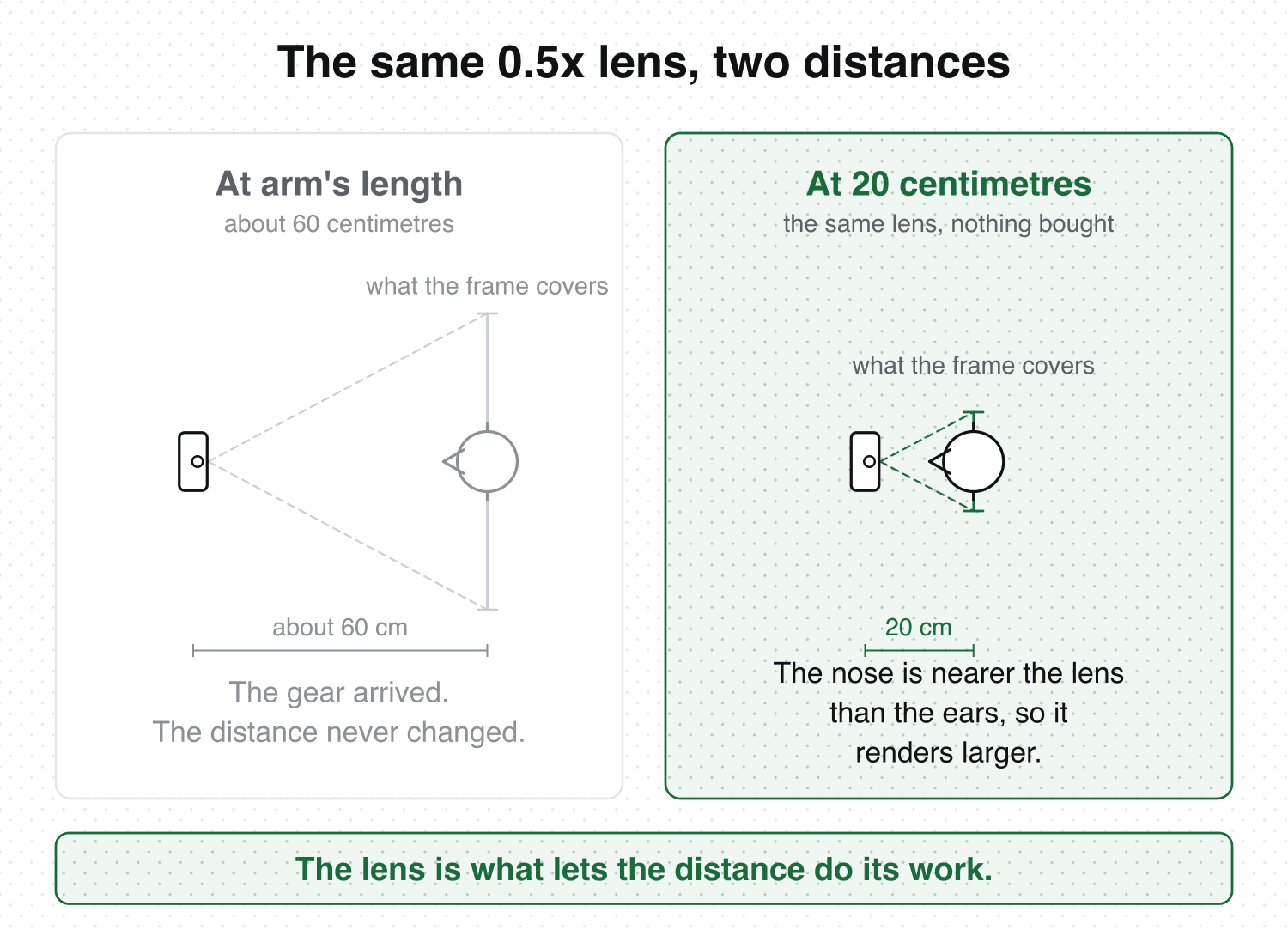
What a wide lens actually buys you is permission to get close. At 20 centimetres a normal phone lens sees a nostril. An ultra-wide sees the whole head plus the room behind it, so the exaggeration has something to play against. The lens is what lets the distance do its work.
This is why people buy a clip-on, shoot from arm’s length, and conclude it was a waste of money. The gear arrived. The distance never changed.
You already know which videos do this well, because you stopped on them. What is harder is working out what the shot was actually doing — how close the camera sat, how long it held before the cut, what the text was doing while the face moved. Hookova takes a Short you paste in and breaks it down beat by beat, and the ones that stop your scroll get saved into a library that stays organized across TikTok, Instagram, and YouTube Shorts, so the reference is open the next time you plan a shot. Try it on the last video that made you stop.
There is one part of the look your 0.5x genuinely cannot produce. Phone ultra-wides are rectilinear: the software straightens the image so the doorframe behind you stays a straight line. A real fisheye is curvilinear. It lets lines bow, and that bowing is barrel distortion — the thing that makes a shot read as fisheye.
Two ways to get the bend.
In the editor, free. CapCut and VN both carry a lens-distortion effect. Push it to roughly 30–40% over footage you already shot at 0.5x. Any higher and the edges smear, because you are stretching pixels that were never there. Do this on a copy — distortion is destructive, and you will want the flat version back.
With glass, about $25. A clip-on fisheye is the one purchase worth making, and only once this is a shot you keep coming back to. Buy one wide enough for your phone’s sensor, or you get vignetting in every corner. Clip it over the 1x lens. Stacking it on top of the ultra-wide is what produces the soft corners in those reviews.
Three things break at this distance, and all three are fixable before you shoot.
It focuses badly. Most phone ultra-wides have a longer minimum focus distance than the main lens, so at 20 centimetres they hunt and settle soft. Back off to 25 or 30 and tap to lock focus on the eyes.
It gets noisy. The ultra-wide sits behind the smallest sensor on the phone. In a dim room it will be visibly grainier than the same shot at 1x. Put a window or a lamp in front of your face and the problem disappears.
It picks a chin. At this range camera height stops being a preference. Slightly above eye level and angled down flatters; below eye level hands the frame to a jaw and a nostril. Comedy wants the second one. Almost nothing else does.
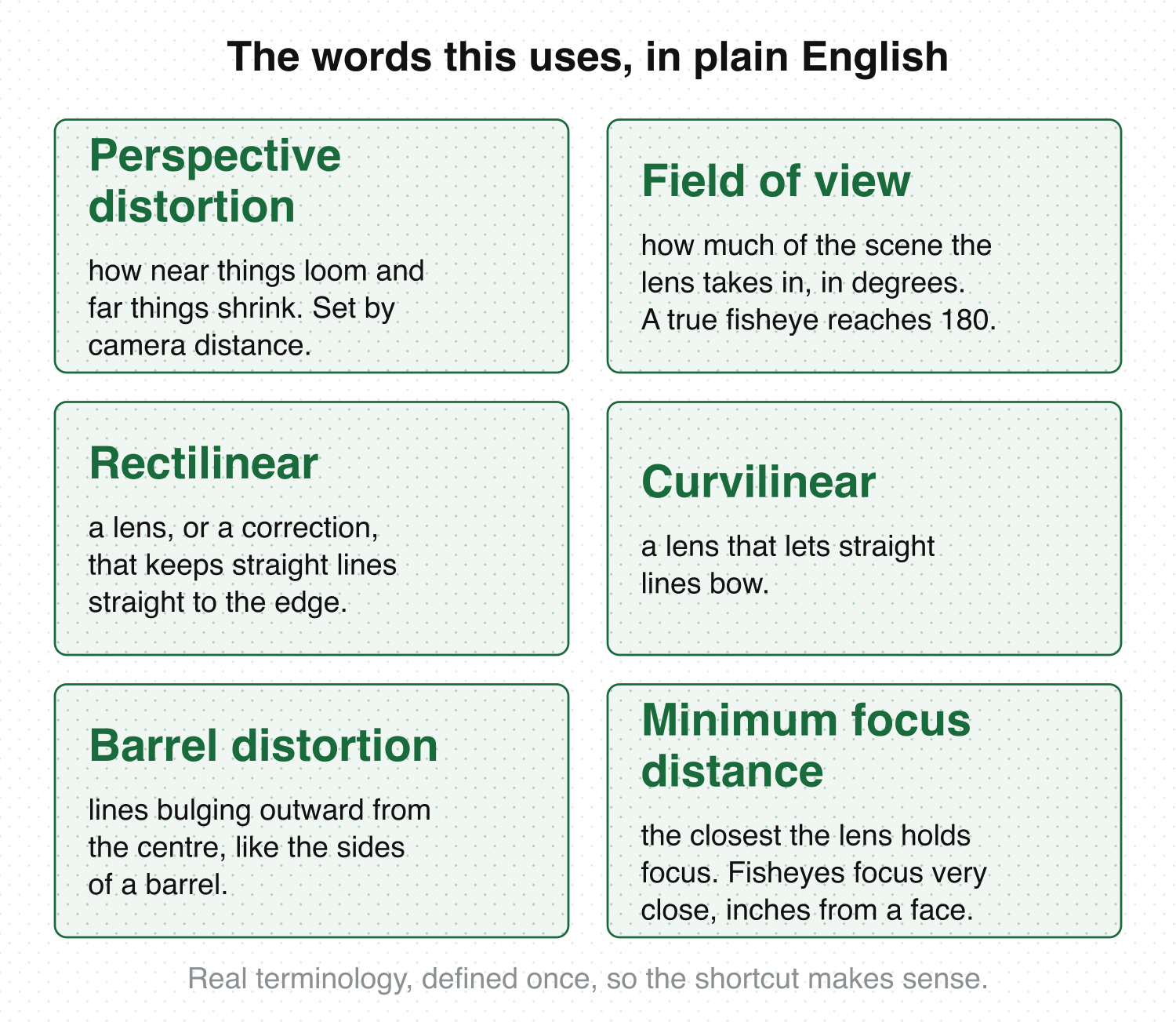
These come from optics, where the vocabulary for “why does this face look wrong” already exists. Six terms carry most of it.
Perspective distortion — how near things loom and far things shrink. Set by camera distance.
Field of view — how much of the scene the lens takes in, in degrees. A true fisheye reaches about 180.
Rectilinear — a lens, or a correction, that keeps straight lines straight to the edge.
Curvilinear — a lens that lets straight lines bow.
Barrel distortion — lines bulging outward from the centre, like the sides of a barrel.
Minimum focus distance — the closest the lens holds focus. Fisheyes focus very close, which is why the shot works inches from a face.
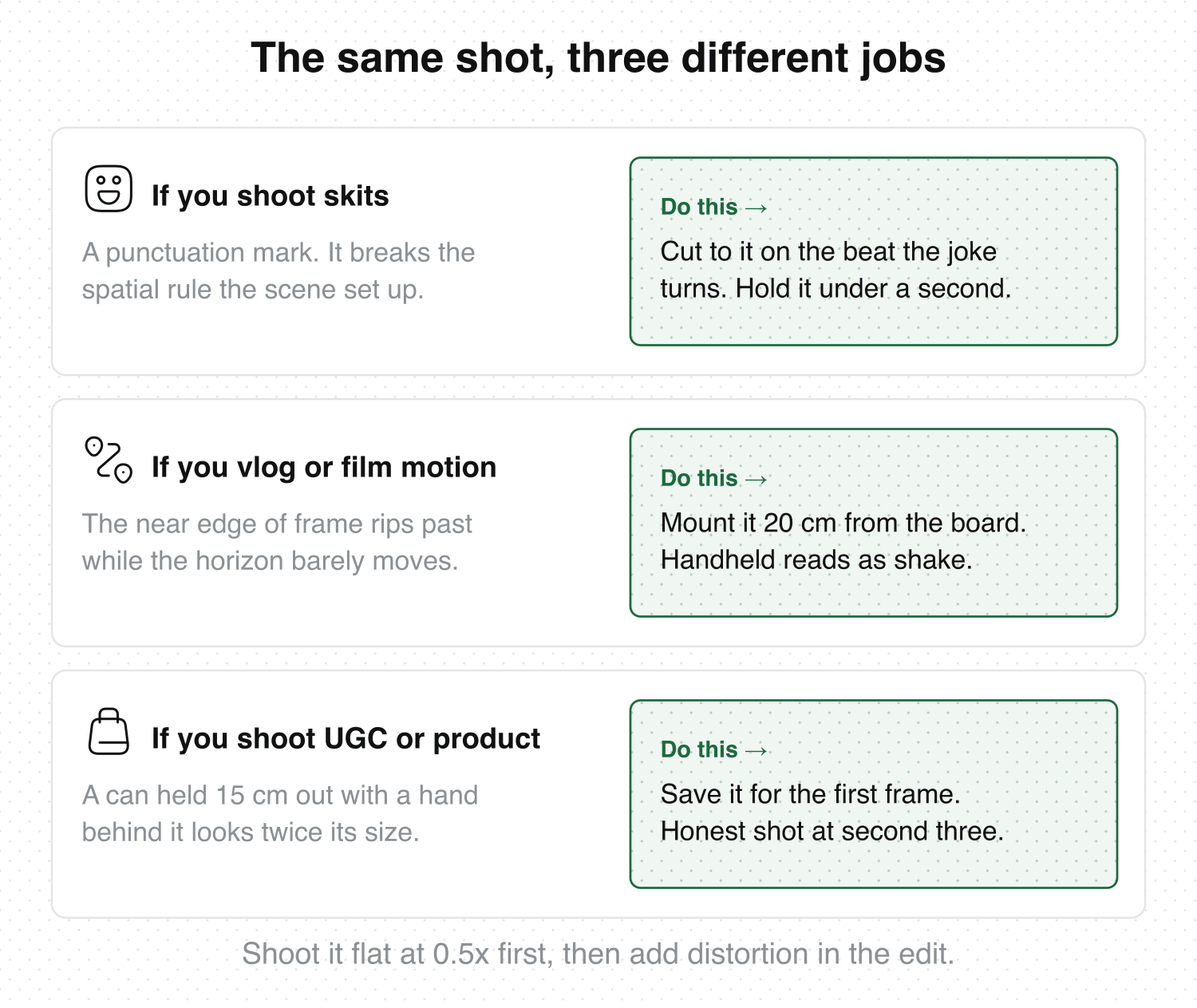
If you shoot skits, this is a punctuation mark. Cut to the distorted close-up on the beat the joke turns, hold it under a second, cut out. It works because it breaks the spatial rule the rest of your scene established, so it lands the way a dutch angle lands — the audience feels the shift before they name it. Used on every shot it stops meaning anything.
If you vlog or film movement, mount wide and mount close. A phone 20 centimetres from a handlebar, a board, or your own chest turns ordinary speed into something violent, because the near edge of frame rips past while the horizon barely moves. Fix the phone to the moving thing. Handheld at this distance reads as shake.
If you shoot UGC or product, put the product at the lens and the minimum focus distance does the selling. A can held 15 centimetres out with a hand behind it looks twice its real size. Brands reject this when the product has to look accurate, so save it for the first frame — you need the scroll to stop, and the honest shot can come at second three, before the drop-off that hits every video around second eight.
Shoot it flat at 0.5x first, then add distortion in the edit. Footage that was already bent cannot be unbent, and the flat version is the one you will want for half your cuts. Our hook examples guide collects openings built on shots like this, and Hookova will take any Short you paste in and show you its structure second by second — save anything, analyze any Short.
Switch to the 0.5x ultra-wide and shoot from about 20 centimetres. That gives you the looming perspective. For the curved lines, add a lens-distortion effect in CapCut or VN at around 30–40% afterwards. The two together get close enough that most viewers will not tell.
Field of view and how they handle straight lines. A wide-angle is rectilinear, so straight lines stay straight to the edge. A fisheye is curvilinear and reaches about 180 degrees, letting lines bow outward. Your phone’s ultra-wide is a corrected wide-angle.
No. It is an ultra-wide at roughly 13mm equivalent with rectilinear correction applied in software, so it captures a lot without bending straight lines. It gives you the perspective exaggeration of a fisheye but none of the curvature.
Select the clip, open Effects, and search for lens or distortion — the exact name moves between versions. Apply it and pull the intensity to about 30–40%. Beyond that the frame edges smear, because the effect is stretching pixels the sensor never recorded.
On a full-frame camera, roughly 8mm to 16mm. Circular fisheyes sit around 8mm and project a round image inside a black frame; full-frame fisheyes run 15–16mm and fill the whole rectangle. Phone ultra-wides are near 13mm equivalent but corrected, so the number alone does not tell you the look.
Because of how close you have to be. At 20 centimetres the nose is meaningfully nearer the lens than the ears, so it renders larger. Back up to two metres with the same lens and the face looks normal again.
 Hookova