Your best Reel this month did 40,000 views. The comments were good. People saved it. And the shop did roughly what it does every other week. If you’re trying to monetize Instagram, that’s the moment the whole thing stops making sense.
Almost nothing written on the subject addresses that gap. Reach has a thousand guides behind it. Turning reach into revenue is where people quietly get stuck, and the reason usually traces back to a decision that was never made.
Are you trying to grow an audience, or sell something?
Those need different formats, different pacing, and different endings. Content made without deciding tends to land between the two — too promotional to grow, too vague to sell. It collects views because the hook worked, and converts nothing because it was never built to.
I’ve watched this play out repeatedly running content for other people. A video performs, everyone’s pleased, and the client asks the only question that matters: so how many did we sell? Nobody has an answer, because the video was never designed to produce one.
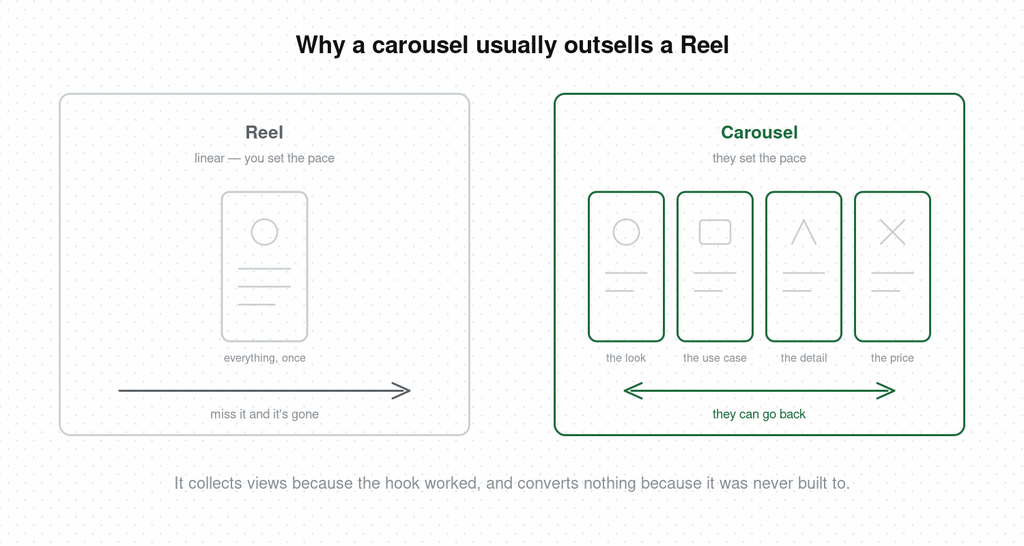
A video is linear. A viewer who misses the point has missed it, and you can’t get them back. A carousel hands pacing to the reader, and each slide can carry a different dimension of the product — the look, the use case, the detail, the price, the reason to act.
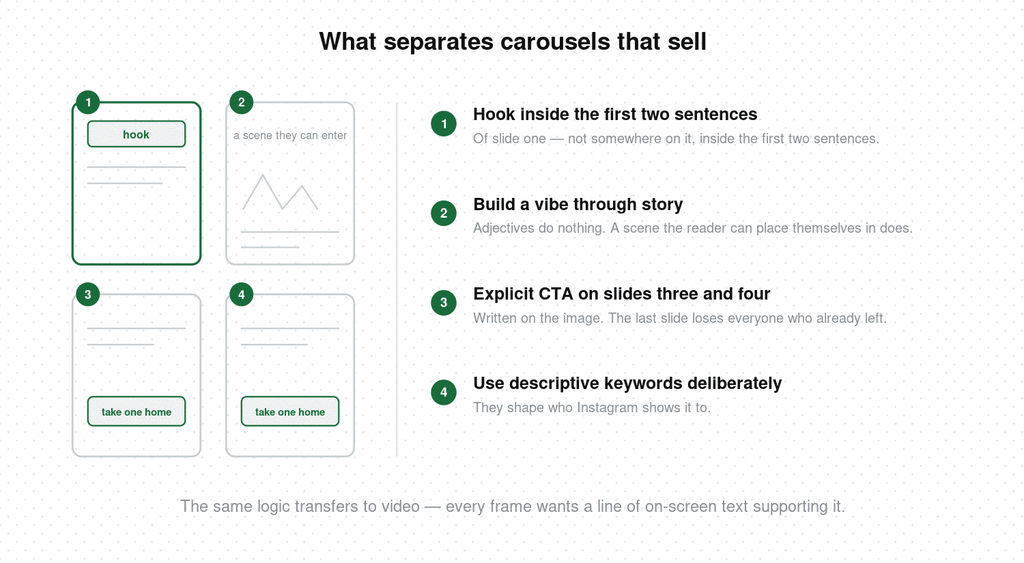
For anyone making official product content or brand work, that structural difference matters more than production value does. Four things separate carousels that sell from carousels that get scrolled past, drawing on what Instagram’s own @creators account has been pushing:
1. Hook inside the first two sentences of slide one. Not somewhere on the first slide — inside the first two sentences.
2. Build a vibe through story, skip the feature list. “Refreshing” and “great taste” do nothing. A scene does: walking through the forest this morning, everything felt new, so I took out the incense I’d brought and lit it there in the open field… The reader places themselves in it. Adjectives never do that.
3. Put an explicit CTA on slides three and four. Directly on the image — “want the same thing in your own space? take one home.” Saving it for the last slide loses everyone who left early.
4. Use descriptive keywords deliberately. They shape who Instagram shows it to and whether the right person recognises themselves in it.
The same logic transfers to video. Descriptive keywords still matter, and every frame wants a line of on-screen text supporting it. One warning from experience: never drop a paragraph on screen at once. Break it with line breaks and emoji — it reads faster and people stay longer, which feeds straight back into completion rate.
You’ve scrolled past product content that clearly had this figured out and kept moving. Hookova makes those keepable: save any Reel or carousel in one click, then analyze the ones you choose and they come back broken down piece by piece, so the structure that’s converting for someone else becomes something you can study, long after the screenshot would have been lost.
Here’s a threshold nobody publishes, from running a lot of new Instagram accounts.
On Instagram, 1,000 views is the ceiling of the entry pool. Below that, your video circulated inside the test audience and stopped. Break it and the algorithm has decided your content is worth showing to people who don’t follow you.
This matters because it separates two very different problems. Stuck under 1,000 is a content problem — the hook failed, and no CTA rescues a video nobody watched. Clearing 1,000 with no sales is a format problem, which is what everything above is about.
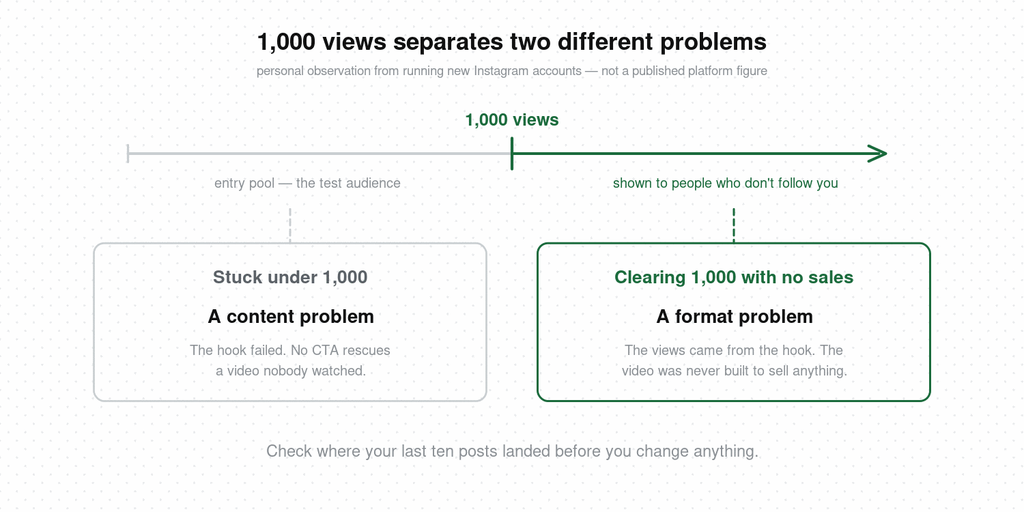
Check where your last ten posts landed before you change anything. → What a view count is telling you
Thresholds shift by region and get revised often, so treat these as the current shape and check in-app:
| Roughly | What opens up |
|---|---|
| 500 followers | Gifts — viewers send small amounts directly |
| 1,000 followers | Professional monetization features, bonus eligibility where offered |
| 10,000 followers | Subscriptions, and most brand outreach starts taking you seriously |
One note on platform payouts, since people ask: Reels bonuses are widely reported around $0.03–$0.12 per thousand views, invitation-based and restructured often. Treat them as pocket change and move on.
Brand deals appear nowhere in that table. They have no follower gate at all. Small accounts with a defined niche and high completion rates win paid partnerships that larger, vaguer accounts miss — that door opens earliest, and most creators ignore it while waiting on an arbitrary number.
Under 500 followers — build the thing you’ll sell. No platform feature is open to you, and none of this is lost time. Pick a niche narrow enough to describe in five words. Post often enough to learn what lands. Get your completion rate up.
500 to 1,000 — turn on gifts, expect nothing from them. Enabling takes two minutes; treat the income as noise. The real work is unchanged: find a repeatable format that clears 1,000 views.
1,000 to 10,000 — brand deals start here. Stop waiting to be found. Build a one-page media kit: niche, typical view range, completion rate, audience demographics, three best-performing examples. Approach small brands you’d actually use. Specificity wins at this size — “my audience is X, this format gets Y, here’s what I’d make for you” — because reach isn’t your argument.
10,000+ — subscriptions and recurring revenue. You can charge your audience directly, brands start approaching you, and affiliate revenue compounds because small conversion rates finally have volume behind them.
Personal brand and lifestyle creators monetize through relationship — subscriptions, partnerships, your own products. It depends on people feeling addressed by a real person, which is why showing your face and holding eye contact affects conversion far more than views.
Faceless and multi-account creators have no personality to sell, so the route runs through affiliate links, digital products, and volume. You can scale a format across accounts; brand deals come harder without a face attached.
Local businesses should ignore platform monetization entirely. A Reel that gets 800 local views and fills three tables beats one that gets 80,000 national views and fills none.
UGC creators sell production. The audience is the brand’s problem, so follower count barely matters — a portfolio proving you can make ads that convert is what sells. Some of the busiest have under 1,000 followers.
How many followers do you need to monetize Instagram?
Around 500 for gifts, 1,000 for professional monetization features, 10,000 for subscriptions. Brand partnerships have no threshold — those depend on your niche and engagement, and small focused accounts get them regularly. Thresholds vary by country and change often, so check in-app for what’s available to your account.
How much does Instagram pay per 1,000 views?
Reported figures generally sit around $0.03 to $0.12 per thousand views for bonus programs, which are invitation-based and not offered everywhere. At those rates, platform payouts amount to pocket change for most creators.
Can you monetize Reels without 1,000 followers?
Through platform features, mostly no. Through brand deals, affiliate links, or selling your own product or service, yes — none of those have a follower requirement. This is the main reason small accounts shouldn’t wait at the gate.
What’s the difference between gifts, subscriptions, and bonuses?
Gifts are one-off payments from viewers on individual Reels. Subscriptions are recurring monthly payments for exclusive content, available from around 10,000 followers. Bonuses are payments from Instagram based on performance, offered by invitation and restructured frequently.
Do you need a business account to monetize Instagram?
You need a professional account, which comes in Creator and Business variants. Creator accounts suit individuals and give better audience insights; Business accounts add contact buttons and shop features that local businesses need. Switching is free and reversible.
How long does it take to start earning on Instagram?
Highly variable, and mostly determined by how quickly you find a format that consistently breaks out of the entry pool. Creators who post daily in a defined niche typically reach brand-deal viability in three to nine months. The bottleneck is finding a repeatable format. Time served on its own does little.
Every route above runs through the same bottleneck: content built to do one job, done well enough that someone acts on it. Hookova breaks a finished Reel down second by second — hook, framing, pacing, where the CTA lands — so you can compare yours against the ones already converting in your niche and see what the difference actually is. For the full range of opening techniques it recognizes, see the video hooks guide.
 Hookova