Your video needs three seconds at the top to explain what it is. The problem is that people leave during those three seconds, and the good part never gets seen.
Storytellers solved this a long time ago, and the solution has a name. It’s the reason Titanic can open on an old woman in the present and drop you into 1912 without a single line of exposition.
A framing device is an outer layer of story that contains the main one. A narrator telling it to someone. A document being read. A scene at the start you return to at the end. The inner story sits inside that container, and the container does the explaining so the story doesn’t have to.
The classics are all built this way. Frankenstein arrives through a letter from an arctic expedition. The Princess Bride is a grandfather reading to a sick kid. Citizen Kane hangs an entire life on a reporter chasing one word. Slumdog Millionaire delivers a childhood through a police interrogation.
In every case the frame does the same job: it establishes who’s telling this, why, and what kind of thing you’re about to watch — before the content starts. That’s what makes it possible to open in the middle of the action.
You don’t have room for a bookend scene. You have the first line.
In short-form video, the framing device compresses into one phrase that tells the viewer what kind of thing they’re watching and what the rules are. It usually lives in the first-frame overlay or the first spoken sentence. Once it’s set, you can start already in motion, because the frame has quietly filled in everything the viewer needed to know.
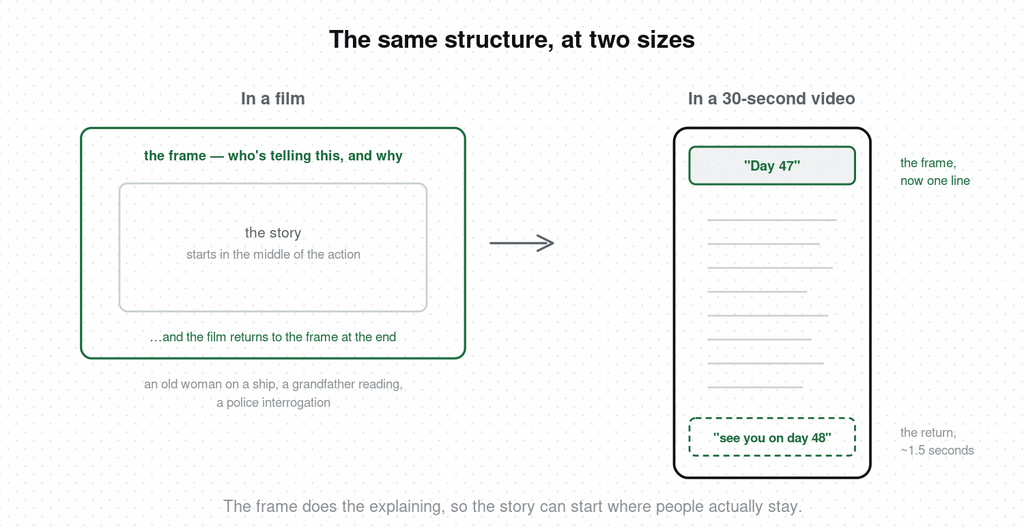
“Day 47” implies forty-six days you never have to show. “I asked 100 people” implies a process. “POV: you’re the new hire” hands the viewer a role and a reason to keep watching — they’re now checking whether you got their experience right.
The setup you skipped is the three seconds you were losing.
You’ve saved videos whose opening line did this and felt impossible to reverse-engineer afterwards. Hookova is built for that: save any TikTok, Reel, or Short in one click, then analyze the one you want and get it broken down second by second — what the first line establishes, what it lets the video skip — so the structure is still there when you sit down to write your own.
The role assignment. “POV: you’re…” casts the viewer as a character. They stay because they’re being depicted, and the whole video becomes a test of accuracy. Scripted formats run on this one.
The series marker. “Day 47,” “attempt eleven,” “week three of…” A number implies a history the viewer missed, and missing something creates a small pull toward catching up. It also gives you permission to start mid-effort, tired, unpolished.
The process frame. “I tried X for thirty days.” “I asked 100 people.” The frame promises a method and a result, so the viewer stays for the number at the end. This one has the strongest completion rate of the five, because the payoff is explicitly withheld.
The retrospective frame. Telling it from after it happened: “this is the message I shouldn’t have sent,” “here’s what I found in the box.” Tension arrives without anything dramatic happening on camera, because the outcome is already known to exist and not yet to the viewer.
The document frame. A screen recording, a notes app, a receipt, a DM thread, a whiteboard. The artifact carries credibility that nobody has to perform. So does a single object that stands in for the idea — a visual metaphor can carry the whole frame. It’s the most useful container if you don’t appear on camera, and the cheapest to produce.
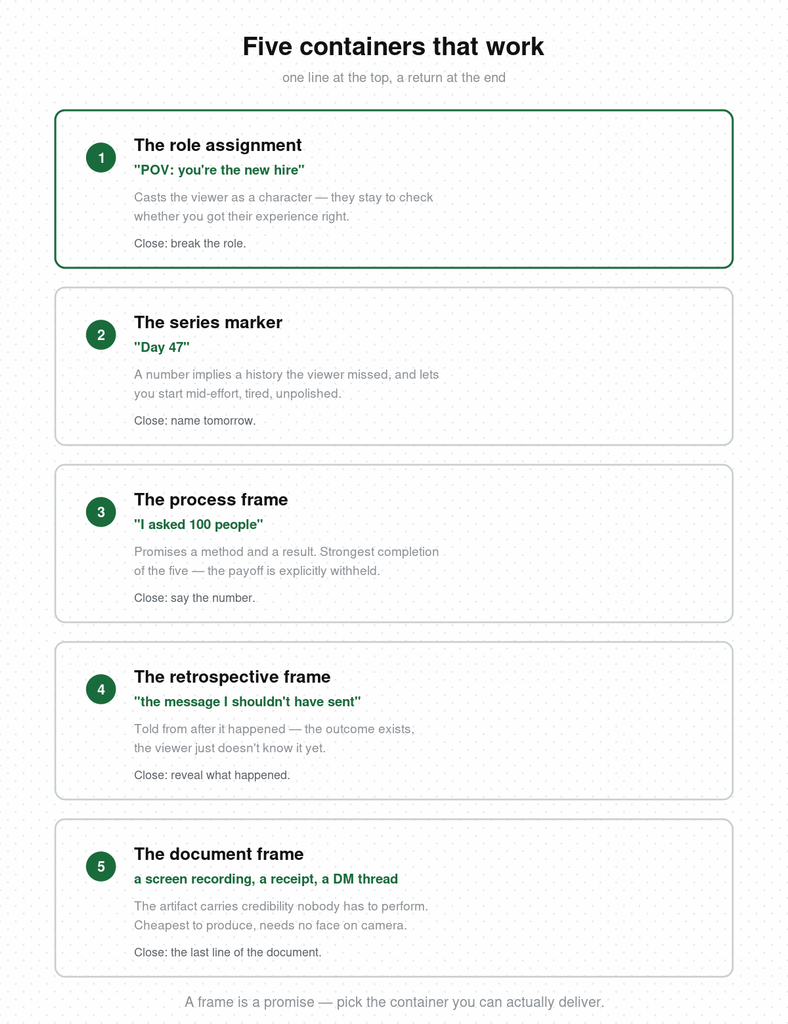
A frame is a promise, and the video has to pay it. “I asked 100 people” with eleven answers on screen reads as a lie, and viewers are unusually good at spotting the shortfall. A series marker on day one has nothing behind it. A retrospective that never reveals what happened wastes the tension it built. Pick the container you can actually deliver, then give slightly more than the opening line promised.
The reason frames work in film is the return. The story ends, you cut back to the old woman on the ship, and the whole thing closes.
Most short videos have no ending. They stop. The viewer feels the drop, doesn’t save it, doesn’t follow, and moves on — and a weak close costs you more than a weak middle, because completion rate is a distribution signal.
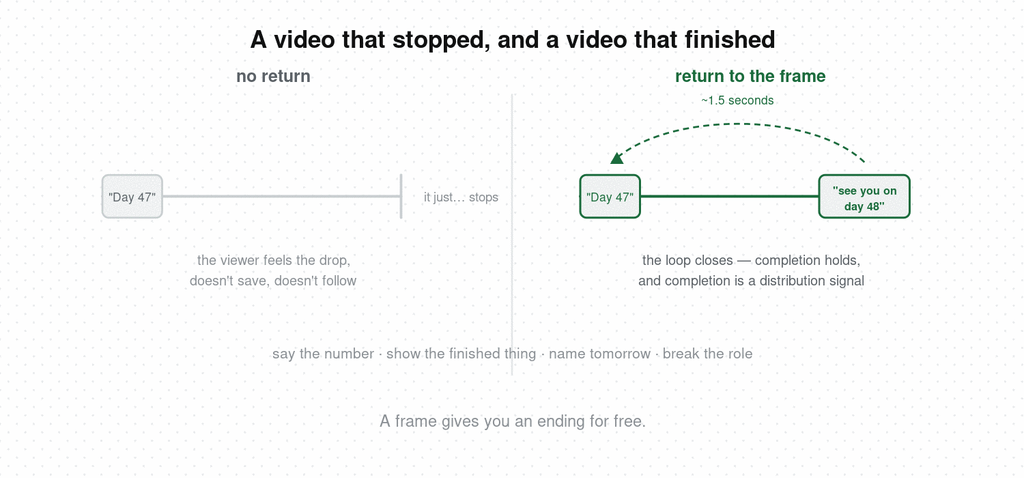
A frame gives you an ending for free. Return to it in the last two seconds. A process frame closes on its result — “so, out of a hundred, eleven.” A series marker closes by naming tomorrow. A document frame closes on the last line of the document. A role assignment closes by breaking the role.
It takes about a second and a half, and it turns a video that stopped into a video that finished.
Knowledge and education. The process frame carries your credibility without you claiming any. “I read forty papers on this” establishes authority in five words and holds people to the end, where the conclusion lives.
Personal brand and lifestyle. The series marker is yours — fifteen vlog frames are built on it. It converts ordinary footage into an ongoing thing people can follow, and it removes the pressure for any single day to be interesting.
Skits and short drama. Role assignment, every time. It compresses the premise into one line so you can open on the conflict already happening, with no scene-setting to shoot.
Faceless and multi-account. The document frame. Screen recordings and artifacts need no face, no voice performance, and no shooting day, and the same container can be reused across accounts without looking like a template.
The frame is a decision you make before recording, because it changes what you need to capture. Choose it first and the shoot gets shorter, the script gets shorter, and the video starts in the place people actually stay for.
What is a framing device?
A framing device is an outer story that contains the main story — a narrator, a document, or a scene at the beginning that the work returns to at the end. Its purpose is to establish context so the inner story can begin without exposition.
What’s the difference between a framing device and a frame story?
They describe the same structure from different angles. “Frame story” usually names the outer narrative itself, such as the pilgrims in The Canterbury Tales. “Framing device” names the technique of using that outer layer to contain and introduce the inner one.
“What are examples of framing devices in film?” Titanic uses an elderly survivor recounting her voyage. The Princess Bride uses a grandfather reading aloud. Citizen Kane uses a reporter investigating a dying man’s last word. Slumdog Millionaire uses a police interrogation. Each opens outside the main story and returns there at the end.
How do you use a framing device in a short video?
Compress it to one line in the first frame or first sentence — a role (“POV: you’re…”), a series marker (“Day 47”), a process (“I tried this for a month”), a retrospective (“here’s the message I shouldn’t have sent”), or a document such as a screen recording. The line establishes the rules so the video can start mid-action.
Do you have to return to the framing device at the end?
Returning gives the video a real ending and usually improves completion, which affects how far the platform pushes it. A return takes one or two seconds: state the result, show the finished thing, or answer the question the opening line raised.
What’s the difference between a framing device and a hook?
A hook is anything that stops the scroll in the first second. A framing device is a structure that runs through the whole video, sets the rules at the start, and closes at the end. A framing device often works as a hook; a hook is frequently just an opening line with nothing behind it.
The opening line is doing several jobs at once — stopping the scroll, setting the rules, and promising the payoff. Hookova breaks a finished video down second by second so you can see which job each part is doing in the videos already working in your niche. For the full range of opening techniques it recognizes, see the video hooks guide.
 Hookova