You have forty clips from Tuesday and no idea what the video is. So you search for vlog ideas, get a list of a hundred — morning routine, what I eat in a day, get ready with me — and none of them help, because the problem was never a shortage of days. (Same as skit ideas: the list was never the bottleneck.)
The problem is that a day, filmed, has no tension. Nothing is at stake in breakfast. The vlogs that hold people put an ordinary day inside a frame that gives the viewer a reason to stay until the end.
Every list gives you subjects. What decides whether anyone watches is the container — the one line at the top that tells the viewer what this is and what they’re waiting for. “Day in my life” is a subject. “Day 47 of trying to wake up at 6” is a container, and it’s the same footage.
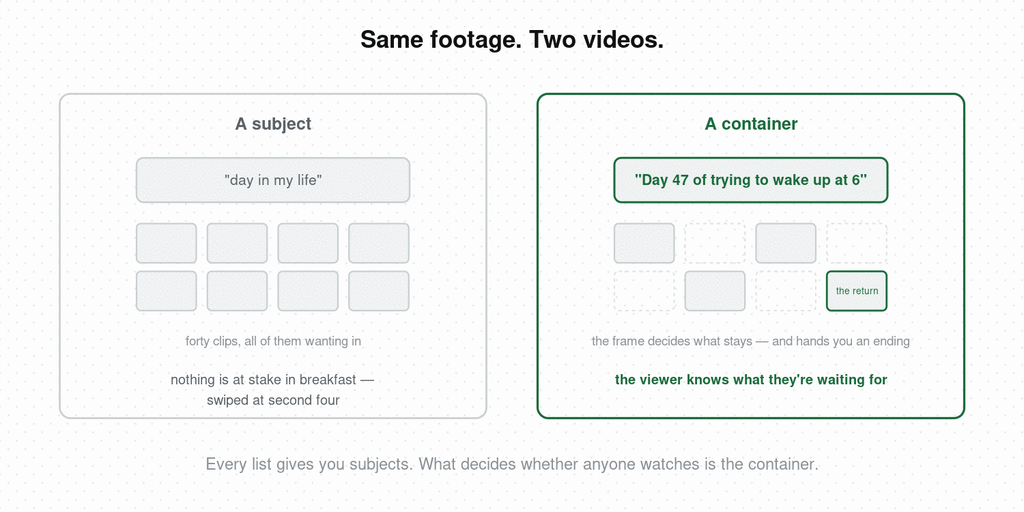
A framing device does that job: it lets you start in the middle and hands you an ending — you return to it, and the video finishes.
The other half is the camera: your eye, a fast push is you noticing, a cut to your face is you reacting. Viewers follow that chain because it feels like being inside someone’s attention. Nothing dramatic has to happen. You have to notice something.
I’ve shot a lot of vlogs, and I’d put them above every other type of video for difficulty. A brief is easy: someone hands you a subject, you serve it. A vlog has no brief, so every clip wants to be in the cut, and the real job — what to leave out — never gets done. You can’t select without a frame to select against.
So the frame gets decided before you leave the house, with one question asked first thing: what am I going out to do today, and what state am I in?
Say the answer is a hike to Joffre Lake. Ten minutes of research tells you what people go there for: the lake at the top and the glacier behind it. That’s your spine, and the shot list writes itself — the drive out, the climb, the summit with glacier and lake, the descent with feet on the trail and a friend talking, or first-person footage if you’re alone. You walk out knowing what the video contains.
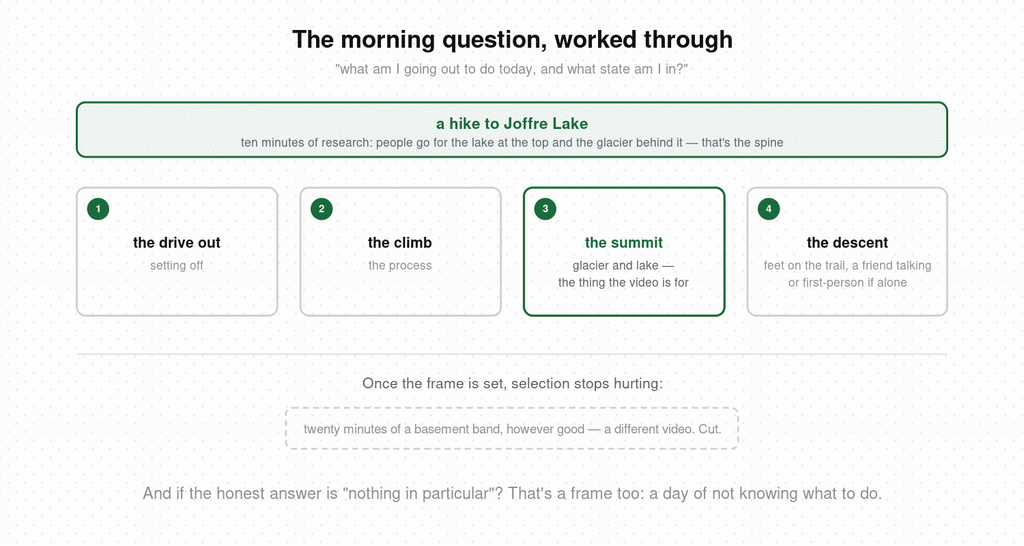
And if the honest answer is “nothing in particular”? That’s a frame too: a day of not knowing what to do. Your life is the subject; the frame names which part.
Once the frame is set, selection stops hurting. If today is a work-log day and you also filmed twenty minutes of a basement band, the band goes, however good it was — it’s a different video. The question underneath is the one that runs through everything here: what am I trying to say? Know that, and what to shoot, skip, and cut all have a direction, and recording stops feeling like a weight you carry all day.
If you’re new: for the first three months, the only goal is getting used to the camera and posting daily. Quality is off the table. The lens stops feeling like a lens around week six.
Somewhere in your saves is a vlog that made a nothing day feel like something. Hookova shows you what it did: save any TikTok, Reel, or Short in one click, choose it from your library, and it comes back broken down second by second — the line at the top, the moment it returns to, where the face cuts in.
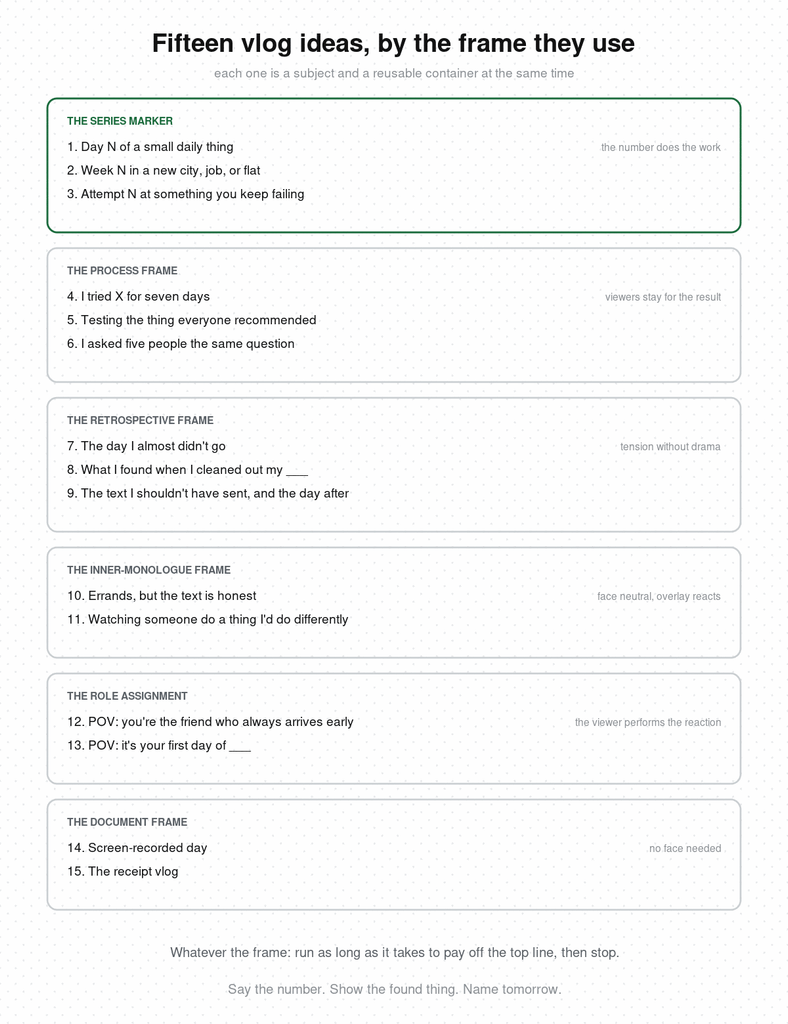
The series marker — a number implies a history and lets you start mid-effort.
The process frame — promise a method and a result; viewers stay for the number.
The retrospective frame — tell it from after, and tension arrives without anything dramatic on camera.
The inner-monologue frame — face neutral, on-screen text says what you’re actually thinking.
The role assignment — cast the viewer and they stay to check you got it right.
The document frame — for anyone not showing their face.
Lifestyle and personal brand. Series markers, then retrospective. The marker turns ordinary days into a thing people follow; the retrospective gives your one interesting moment a whole video.
Faceless. Document and inner-monologue frames need no face and no voice. A screen-recorded day with honest overlay text is a full vlog with nothing of you in it except the point of view.
Local business. The process frame, run on the shop: “we tried the new opening time for a week.” The result is the ending; the customers are the cast.
It’s the second half of 2026, and this only gets more true from here: you don’t have to carry the frame in your head. Ask an assistant before you go out. The models have different temperaments — Claude is good at turning the morning question into a small, orderly shot list; Gemini is better for arguing out what you actually want the vlog to say. Use whichever suits you, or both.
Whatever the frame, the vlog runs as long as it takes to deliver what the top line promised and stops. Say the number. Show the found thing. Name tomorrow.
What are good vlog ideas for beginners?
Series-marker vlogs — “Day N of” a small daily habit — because the number carries the video and lets you post before your footage is good. Pair it with the ninety-day rule: post daily, ignore quality, and let the camera stop feeling like one.
What do you vlog when nothing is happening?
Put the nothing inside a frame. A day of errands becomes a vlog with an honest inner-monologue overlay, a series number, or a retrospective open on the one moment that did happen. The frame supplies the tension the day lacks.
How do you make a boring day interesting on camera?
Notice things. The camera is your eye, a fast push-in is you noticing, a cut to your face is you reacting. Viewers follow that chain because it feels like being inside someone’s attention, which is more compelling than events.
What are faceless vlog ideas?
Document frames: a screen-recorded day, a receipt trail, a calendar filling up. Inner-monologue frames also work with the face out of shot — hands, a desk, a view — and the on-screen text carrying the point of view.
How long should a vlog be?
In short-form, exactly as long as it takes to pay off the top line, typically 20–45 seconds. Longer vlogs usually contain two or three moments competing for one slot; split them and give each its own frame.
How often should you vlog?
Daily for the first ninety days if you’re new, with quality explicitly off the table — the goal is getting used to the camera. After that, whatever cadence you can sustain with a frame on every video.
Ideas were never the shortage. The vlogs you finish share a frame at the top and a return at the end, and the fastest way to learn which frames work is seeing them laid out in the videos already holding you. Hookova breaks any saved Short down second by second so the container is visible. For the full range of opening techniques it recognizes, see the video hooks guide.
 Hookova