You filmed something that was genuinely funny, or genuinely impressive, and posted it. The comments treat it like nothing happened. Watch the video again and the problem is visible: the thing happens, and then nobody on screen reacts to it, so nobody off screen does either.
Film solved this a century ago with one of its most basic units of grammar, and it transfers to a phone in a bedroom better than almost anything else.
A reaction shot cuts away from the action to a face responding to it. The shark surfaces; cut to Brody’s face. Something absurd is said in the office; cut to Jim looking at the camera. The action carries the information. The reaction carries the meaning — it tells the audience what they just saw was terrifying, or ridiculous, or a bigger deal than it looked.
That’s the part that matters for short video. Viewers scrolling at speed don’t evaluate what they see; they take the cue from whoever’s on screen. No reaction, no cue. The moment passes as neutral, and neutral gets swiped.
Two things happen at once, and both are worth money.
It assigns the emotion. A viewer who arrived one second ago has no context. The reaction shot hands them a verdict — this is funny, this worked, this is a disaster — and it’s the closest thing short video has to a laugh track that doesn’t feel like one.
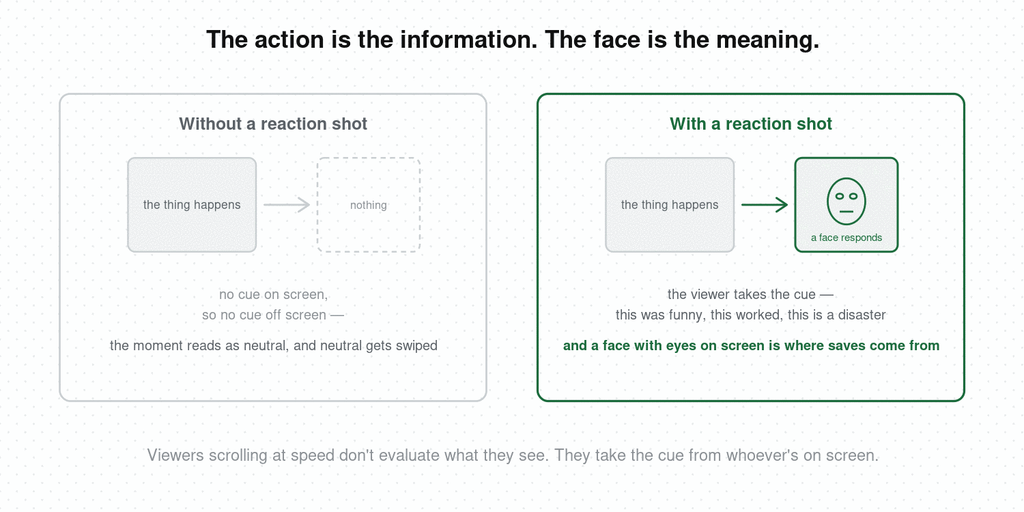
It’s where the conversion lives. Across ten years of running accounts, the same pattern holds: a visible face beats no face, visible eyes beat hidden ones, eye contact beats a drifting gaze. The gap barely shows in views; it shows entirely in saves, follows, and comments written as though to a person. The reaction shot is, structurally, the moment the video puts a face and a pair of eyes on screen — direct address with a reason to be there.
Every film guide assumes another actor and a second camera. You usually have neither.
Your own face, after your own line. Deliver the setup, cut to the thing happening, cut back to your face. Same person, same phone, three takes — the native grammar of the format.
The look to camera. Something happens, and you turn to the lens with no expression at all. (Alone with no second angle, a crash zoom onto your own face does the same job.) The Jim Halpert move, and the most efficient reaction shot there is — the viewer becomes the person you’re sharing the look with.
The bystander. A friend, a dog, a stranger in the background. Unrehearsed, so it reads as proof: someone who wasn’t in on it reacted anyway.
The viewer as the reaction. A POV framing puts the viewer in the reacting seat — “POV: your roommate just said this” — so they perform the reaction themselves. That’s why POV feels so immediate: the reaction shot is the viewer’s own face.
You’ve saved videos where the cut to a face made the whole thing land and couldn’t say why. Hookova shows you: save any TikTok, Reel, or Short in one click, choose it from your library, and it comes back broken down second by second — where the reaction sits, how long it holds, what the eyes are doing.
Reaction video is one of the biggest lanes on TikTok right now, and its most-copied template runs the grammar backwards. Someone travelling films their own face first — mouth open, eyes wide — and then cuts to the view that caused it.
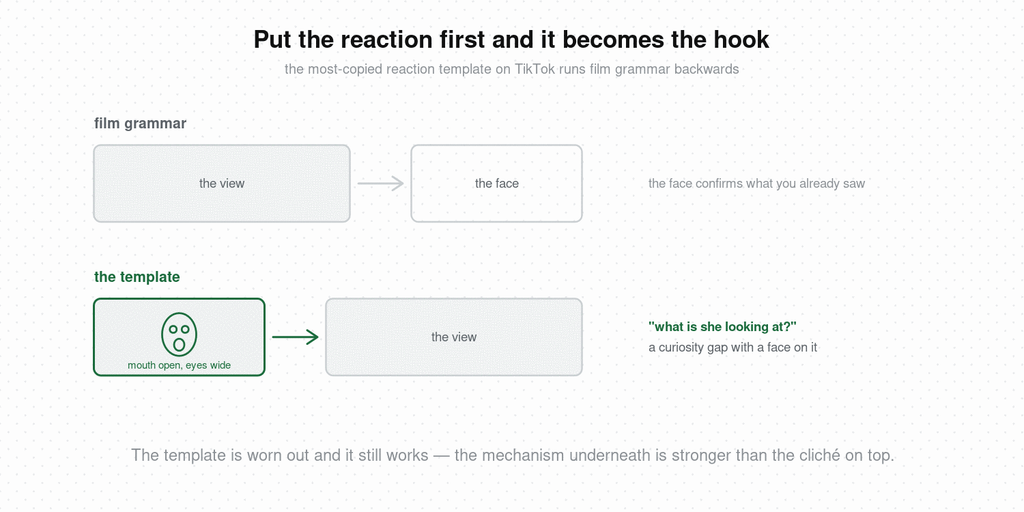
Everyone knows this template, and I’d bet that when one crosses your feed you still watch to the end, because the reaction arrived before the reason and now you have to know: what is she looking at? A reaction shown before its cause is a curiosity gap with a face on it. The template is worn out and it still works, which tells you the mechanism underneath is stronger than the cliché on top.
The version I find more interesting: your face stays neutral while the on-screen text says what you’re actually thinking. The event plays out in front of you, you pretend nothing is happening, and the overlay carries the real reaction. The gap between the calm face and the panicked text is the joke, the tension, or the confession — and it’s a reaction shot that lasts the whole video.
Some setups that run on it:
Watching everyone around you adopt AI at full speed, face composed, text: I’m forty and I have never been this scared.
Your classmate starts cheating; you look bored; text: the invigilator has been walking toward us for eleven seconds.
A customer explains your own product to you wrongly; you nod; text: I built this.
A friend says “I’m fine”; you keep eating; text: she has said fine four times.
Your kid confidently explains something backwards; you listen; text: not correcting this. Not today.
A client asks for “just a small change” on a call; you smile; text: this is the third redesign.
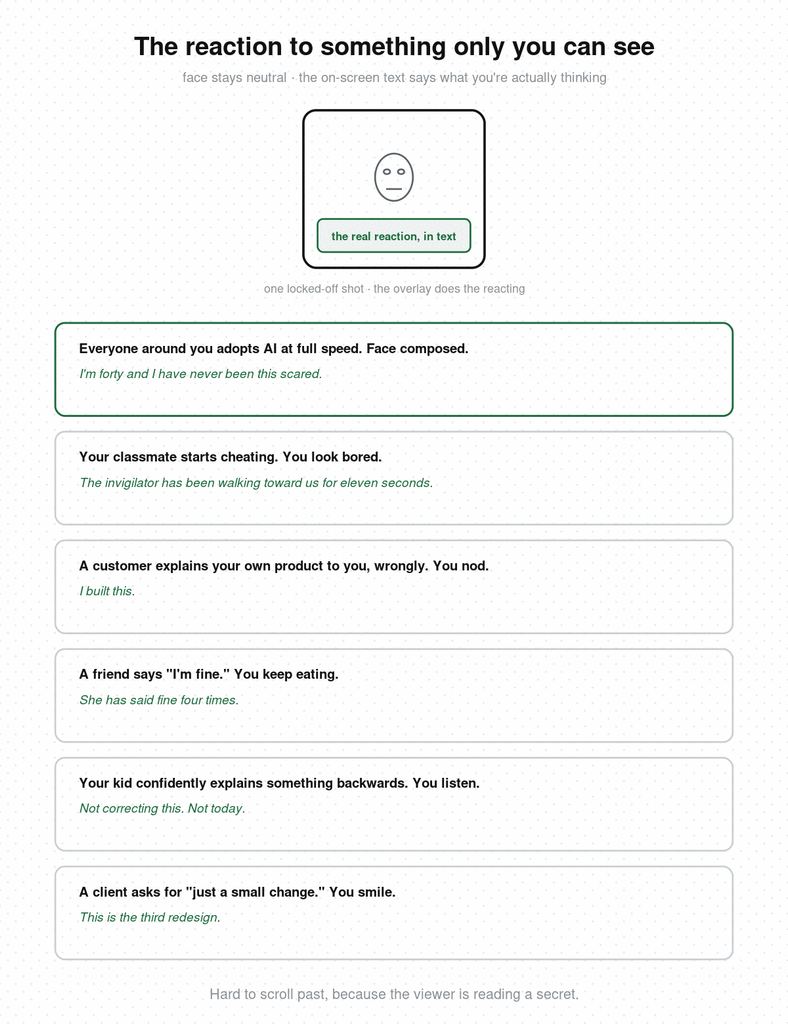
Each one is a single locked-off shot of a face, and the overlay does the reacting. Cheapest reaction video there is to make, and hard to scroll past, because the viewer is reading a secret.
A reaction shot placed wrong is worse than none. Two rules, both borrowed from comedic timing:
Arrive one beat late. The instinct is to cut to the face the instant the thing happens. Wait one full beat, so the viewer registers the action first and the face confirms a reaction they’ve already started having. Too early feels like the video telling you what to think; one beat late feels like agreement.
Hold it, then end there. Hold the face for two beats — long enough for the viewer to have their own response in the space you’ve left — and finish while the second beat is still working. The inner-monologue overlay above is the reaction; a caption that explains what the face means is a reaction shot that didn’t trust itself.
That stillness is the point. The viewer needs room to react, and this is where you give it to them.
Skits. Shoot the reaction as a separate take so the edit can move it. A skit’s opening beat sets the premise; the reaction tells the audience it just paid off. The bigger the event, the smaller the face.
Lifestyle and personal brand. Your reactions are the content. The thing that went wrong is B-roll; your face at the moment you noticed is the video. Film the face first if you can only get one. The vlog frames that hold are built around exactly that face.
UGC and product. The reaction is the sell. A product doing its thing is a demo; a face reacting to it is a testimonial, and the second converts. Keep it small — a raised eyebrow at the price, a second look at the result — because exaggeration reads as advertising.
Local business. Your customers’ reactions are the most persuasive footage you own. A first bite, a first look in the mirror — ask permission, film the face, put it right after the reveal.
What is a reaction shot?
A reaction shot is a cut away from the main action to a face responding to it. It’s one of the basic units of film grammar, used to tell the audience how to interpret what they just saw — as frightening, funny, or significant.
What’s the difference between a reaction shot and a cutaway?
A cutaway is any shot that leaves the main action briefly — an object, a detail, a location. A reaction shot is a specific kind of cutaway that goes to a face responding to the action. All reaction shots are cutaways; most cutaways are not reaction shots.
How do you film a reaction shot alone?
Shoot it as a separate take: deliver the action, then film your own face reacting to camera as if it just happened. Alternatively, use a look to camera — turning to the lens with a flat expression — which needs no second person and casts the viewer as the one you’re reacting with.
How long should a reaction shot be?
In short video, roughly one to two seconds — long enough for the viewer to register the expression and have their own response. Arrive one beat after the action, never on the same frame, and hold without dialogue.
What are famous reaction shot examples?
Chief Brody’s face when the shark surfaces in Jaws; Jim Halpert’s looks to camera in The Office; Clarice Starling’s expressions opposite Hannibal Lecter in The Silence of the Lambs. Each shows the audience how to feel about the action that preceded it.
Do reaction shots work in short-form video?
They’re arguably more important there than in film, because scrolling viewers have no context and take their cue from the face on screen. A reaction shot also puts eyes on camera, which is where saves and follows come from in short-form.
The thing happening is the information. The face after it is the meaning, and meaning is what gets saved. Hookova breaks any saved Short down second by second so you can see exactly where the videos in your niche cut to a face, how long they hold it, and what it’s doing for the ending.
For the full range of opening techniques it recognizes, see the video hooks guide.
 Hookova