You film the bit, you watch it back, and it’s just… not funny. The same joke was funny when your friend said it. It was funny in the video you saved. Somewhere between your head and your camera roll, it died — and you can’t point to where.
Nine times out of ten, nothing is wrong with the joke. What’s off is the comedic timing, and the good news about short video specifically is that timing lives mostly in the edit, where you can fix it as many times as you want.
Stage comedians spend years calibrating this live, because a stage gives you one attempt per audience. You have an advantage they’d kill for: your pause is a cut point, and cut points move.
Comedic timing is control over when the surprise arrives. A joke works by building a small expectation and then breaking it — the setup shapes what the audience thinks is coming, the punchline delivers something else. Land the break too early and there’s no tension to release. Too late and the tension has already leaked away. Comedians manage that arrival with the beat — a deliberate pause — and its heavier cousin the pregnant pause, the silence held right before the punchline, or in its place.
That’s the stage version, and every guide stops there, because on stage the pause is all you have.
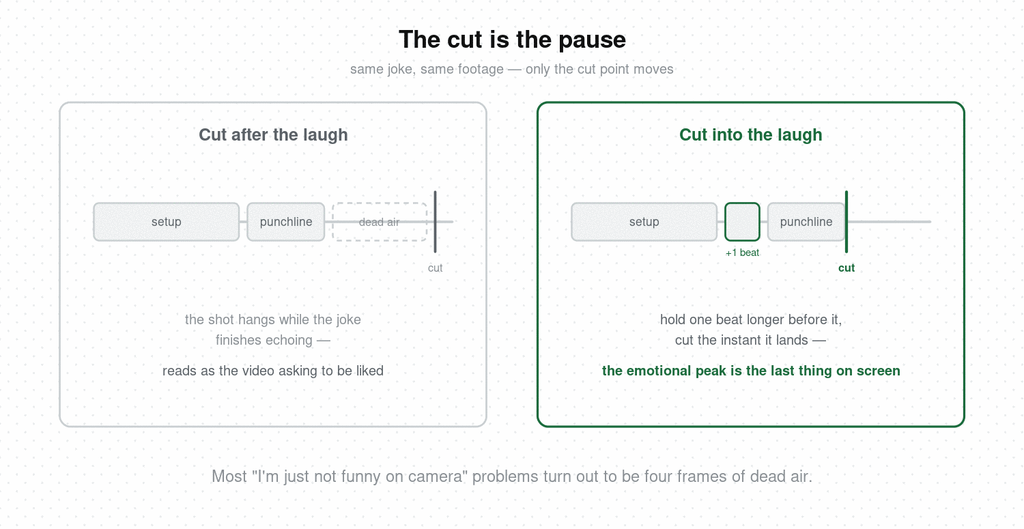
Here’s the part nobody transfers: on camera, a pause and a cut are the same tool. The frame where you cut away is the beat. How long you hold a shot after the line is the pregnant pause. Which means comedic timing stops being a performance talent you either have or don’t, and becomes an editing decision you can redo at ten in the evening in your pyjamas.
The practical consequences:
Cut into the laugh, never after it. The most common timing kill in short video is holding the shot while the joke finishes echoing. The moment the punchline lands, cut. Dead air after a punchline reads as the video asking to be liked.
Hold the shot before the punchline one beat longer than feels right. Tension builds in stillness. When the edit feels slightly uncomfortable to you, it’s usually landing right for a viewer seeing it once.
A smash cut is a punchline with no dialogue. Calm statement, hard cut to chaos — the cut itself delivers the surprise. A crash zoom does the same inside a single shot. It’s the cheapest joke in editing, because the two shots do all the work.
The reaction shot is a second punchline. Cutting to a deadpan face after the joke — one full beat later than feels natural — often gets a bigger laugh than the joke itself. Delay is the whole trick.
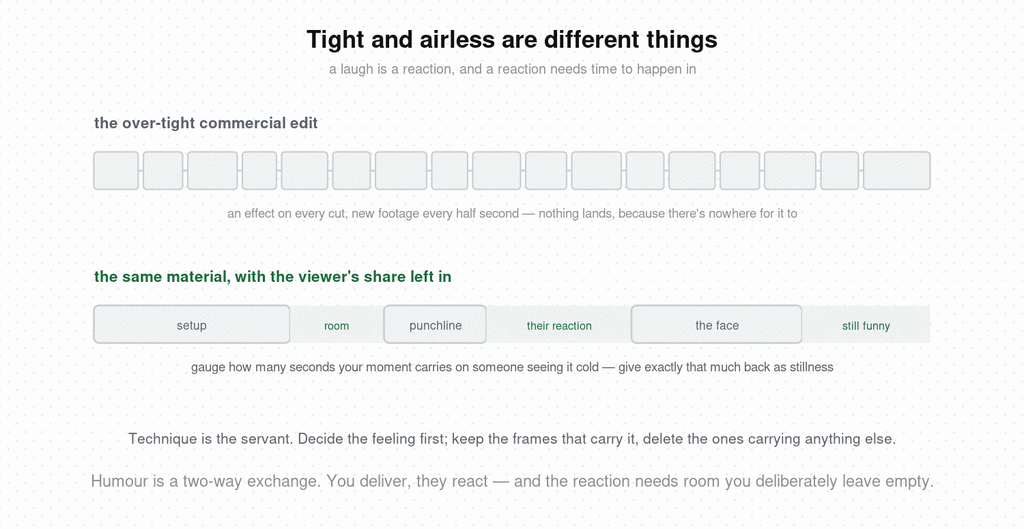
There’s a house style spreading through commercial editing right now: everything packed to the frame, an effect on every cut, new footage every half second. I’ve watched a lot of it cross my desk, and the rhythm is technically impressive and none of it is funny — because a laugh is a reaction, and a reaction needs time to happen in.
The order of operations matters here. Technique is the servant. First decide what you’re expressing — every frame, every sound, every piece of music is an auxiliary to that one thing, and when the feeling underneath is full enough, every beat of the video carries pull on its own. If the thing you’re expressing is this is hilarious, then “cut into the laugh” is simply the choice that shows the emotional peak — and the same principle tells you what to delete: any frame carrying an emotion that isn’t the one you’re transmitting.
Then hand the viewer their share. Humour is a two-way exchange: you deliver, they react, and the reaction needs room you deliberately leave empty. Gauge how many seconds your moment actually carries — how long its effect lasts on someone seeing it cold — and give exactly that much back as stillness. That’s the difference between tight and airless.
Take the most standard three-shot skit: you announce something with confidence, reality disagrees, we see your face.
Shot one — “I meal prep every Sunday. It’s honestly changed my life.” Hold it a half-beat after the line ends; that stillness is the setup doing its work. Shot two — hard cut to the fridge full of takeout containers. This cut is the punchline, so it has to be instant: any transition, any breath between the claim and the fridge, and the surprise dies. Shot three — cut to your face, deadpan, one full beat later than instinct says. Hold two beats. End the video while the second beat is still funny.
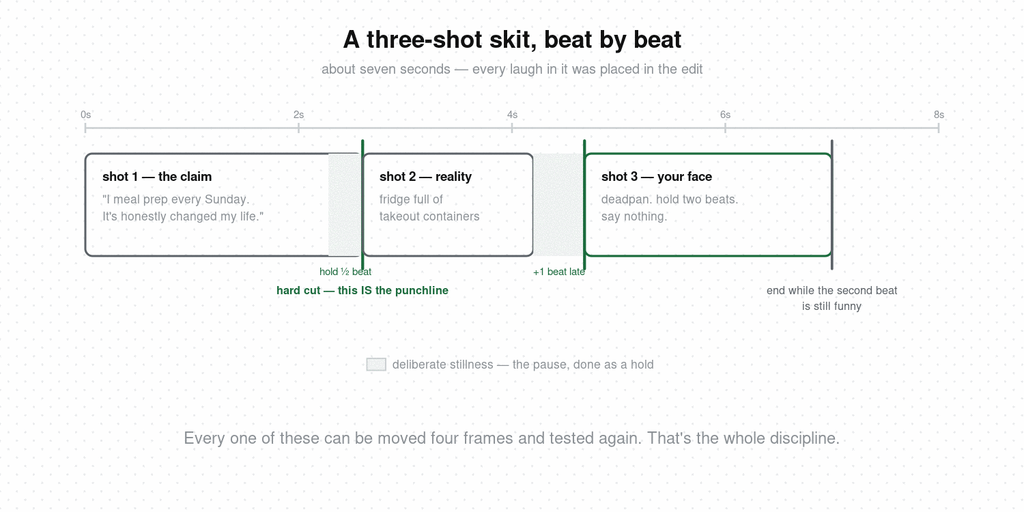
Total runtime, maybe seven seconds. Every laugh in it was placed in the edit, and every one of them can be moved four frames and tested again. That’s the whole discipline.
Timing is nearly impossible to learn from your own footage, because you know when the punchline is coming — you can’t feel the surprise, so you can’t judge the delay. What works is studying videos that made you laugh, half-second by half-second: where the cut lands relative to the line, how long the deadpan holds, when the reaction arrives.
That’s tedious to do with a screenshot folder. Hookova does the tedious part: save any TikTok, Reel, or Short that got a laugh out of you in one click, pick it from your library when you’re ready, and it comes back broken down second by second — where the beats fall, what each cut is doing, how someone else expressed the exact emotion you’re trying to transmit and how many seconds of room they gave it. Rewatch the funny ones next to your own draft and the timing difference stops being mysterious and starts being a number.
Skits and short drama. Timing is your entire product, and it starts before the camera rolls: shoot the setup and the reaction as separate takes so the edit can move them independently. A skit built from a strong premise with lazy cuts loses to a mediocre premise with sharp ones, every week.
Lifestyle and personal brand. Your material is observational, so your punchlines are usually visual — the thing going wrong, the face you make. The move is the deadpan hold: let the chaos happen behind you and keep the camera on your unbothered face one beat past comfortable.
UGC and product content. Humour here is a delivery vehicle, and the timing rule is compression: the first line sets the frame, the product beat lands inside the joke’s rhythm, and anything that delays the surprise gets cut. Funny ad reads die from one extra second of setup.
Add one pass to your editing checklist: watch your draft once, only for timing. At every joke, ask two questions. Is there anything between the punchline and the cut? Kill it. Does the shot before the punchline hold long enough to feel slightly wrong? If not, add half a second. Two questions, once per joke, and most “I’m just not funny on camera” problems turn out to be four frames of dead air.
What is comedic timing?
Comedic timing is control over when a joke’s surprise arrives — using pauses, pacing, and delivery to release built-up expectation at the exact moment it lands hardest. Too early kills the tension, too late lets it leak away.
What is a beat in comedy?
A beat is a deliberate pause, usually a second or less, placed to let tension build or a laugh land. In short video editing, the length of a held shot before or after a line does the same job a spoken pause does on stage.
What is a pregnant pause?
A pregnant pause is an extended silence held right before a punchline — or in place of one — that builds anticipation. On camera, its equivalent is holding a shot noticeably longer than feels comfortable before cutting to the payoff.
How do you improve comedic timing?
Study videos that made you laugh, in slow motion: note where the cut lands relative to the punchline and how long reactions hold. Then edit your own drafts against those measurements. Timing is hard to judge on your own footage because you already know the joke.
How does comedic timing work in editing?
The cut replaces the pause. Cut immediately after the punchline lands, hold the shot slightly too long before it, and use hard cuts as visual punchlines. Most timing problems in short video are dead frames between the joke and the cut.
Can comedic timing be learned?
Yes — in short video more easily than on stage, because the edit is repeatable. Performers need live reps to calibrate; an editor can move a cut four frames, rewatch, and move it again until the beat lands.
The gap between “funny in your head” and “funny on screen” is measured in frames, and the fastest way to close it is seeing exactly where funnier videos put theirs. Hookova breaks any saved Short down second by second so the beats, holds, and cuts are laid out to copy. For the full range of opening techniques it recognizes, see the video hooks guide.
 Hookova