You have a point to make — burnout, clutter, being stuck, the difference your product makes — and every time you say it on camera it takes three sentences. The viewer left after one.
Film, painting, and advertising solved this long ago with a single move: show an image that means the thing. In a feed where most people watch with the sound off, it’s close to the only way a point survives.
A visual metaphor is an image that stands in for an idea, so the viewer understands the idea by looking at the image. The thing you mean is the tenor; the thing you show is the vehicle. A dog with a tiny bowl of food, captioned “more power, less consumption,” is a BMW. Captain Willard’s face superimposed over burning jungle in Apocalypse Now is a man who has become the war. The staircase in Psycho is dread with steps.
It’s different from a symbol. A symbol is a fixed sign — a dove means peace because we agreed it does. A metaphor is an argument: this is like that, and the viewer connects them, which is why it lands harder than being told.
Every definition stops at cinema. On a six-inch screen with the sound off:
A visual metaphor is the claim, delivered as a picture. Your point about burnout becomes a phone at 1% on a bedside table. Your point about clutter becomes a browser with sixty tabs. The viewer reads the image in under a second, and the idea arrives without a sentence being spoken.
It works with the sound off, which is most of your audience. An image is faster than reading.
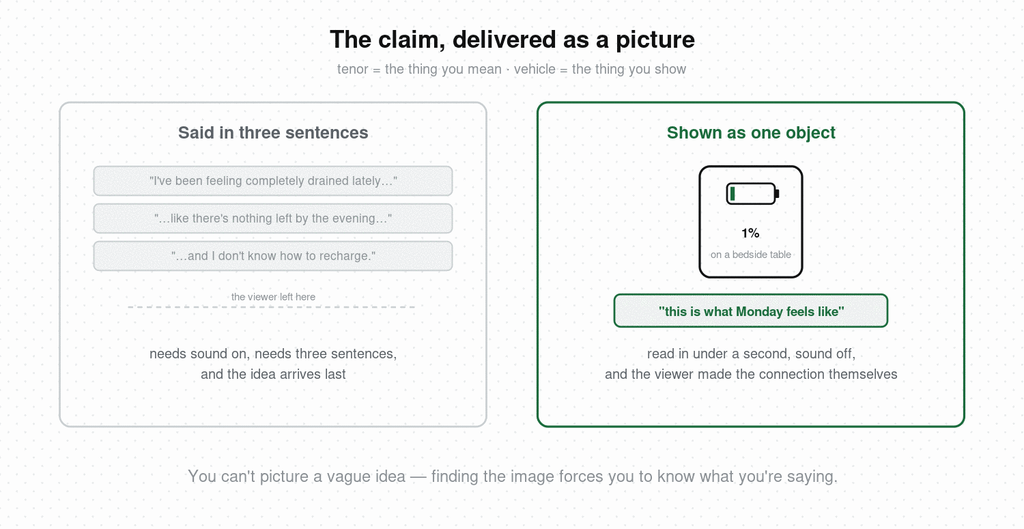
It forces you to know what you’re saying. You can’t picture a vague idea. To find the image you first have to reduce the point to one clean claim — and what am I actually trying to say is the question under every video that works.
From a camera-language point of view, metaphors split in two.
The moving metaphor is an action standing in for a quality. To say someone works hard, film shows the walk to class in the dark, the desk at 2am with one lamp on, the same person alone with a thesis. Nobody says “diligent.” The B-roll says it.
The still metaphor is an object standing in for a fact about a person or a place, and it works on psychological anchoring — the associations people already carry. One shot of a painting in a gallery can mean the story happens in a gallery. It can also mean this person can afford paintings, or spends their weekends looking at them. Nothing was stated, and a portrait is already forming in the viewer’s head. (Camera height does the same job, which is why a tilt or a low angle reads as a statement about a relationship.)
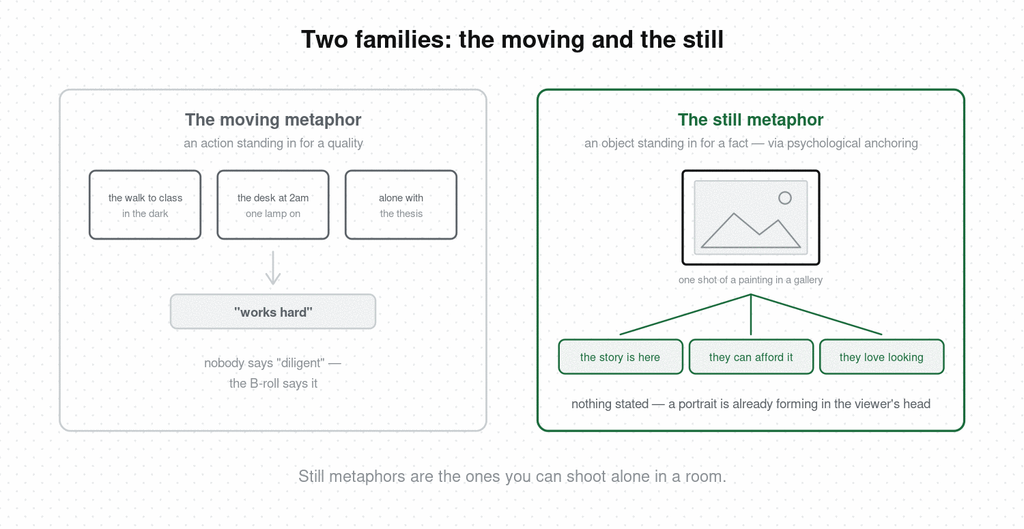
Still metaphors are the ones you can shoot alone in a room, so the rest is mostly about them.
The stand-in. One object replaces the abstract thing. Burnout is the 1% battery. An impossible schedule is a calendar too full to read. Find the object, put it in frame, and you’re done.
The comparison. Two things side by side, one of them absurd. The BMW dog is this. A stack of forty receipts next to one receipt. The juxtaposition does the arguing.
The transformation. The idea shown as a change. A wilted plant on day one, upright on day seven, is recovery. A tangled cable straightened is a process fixed. It has a built-in ending: the video finishes when the transformation does.
You’ve saved videos where one image explained something a paragraph couldn’t. Hookova shows you how: save any TikTok, Reel, or Short in one click, choose it from your library, and it comes back broken down second by second — what the image stood in for, when it appeared, what line sat on top of it.
The metaphor is a natural opening, paired with one line of on-screen text that names the tenor. “This is what Monday feels like” over a phone at 1% is a complete hook in one frame.
Two placements work. Metaphor first, meaning after — open on the image, let the viewer wonder, land the line: a curiosity gap with a picture on it. Meaning first, metaphor as the reveal — say the claim, then crash onto the object that proves it. Stronger for product and education, because the image arrives as evidence.
Either way, the object can carry the whole structure: open on it, return to it at the end — a framing device made of one thing. On camera, a cut to your face after the reveal tells the viewer how to feel about what the object just said.
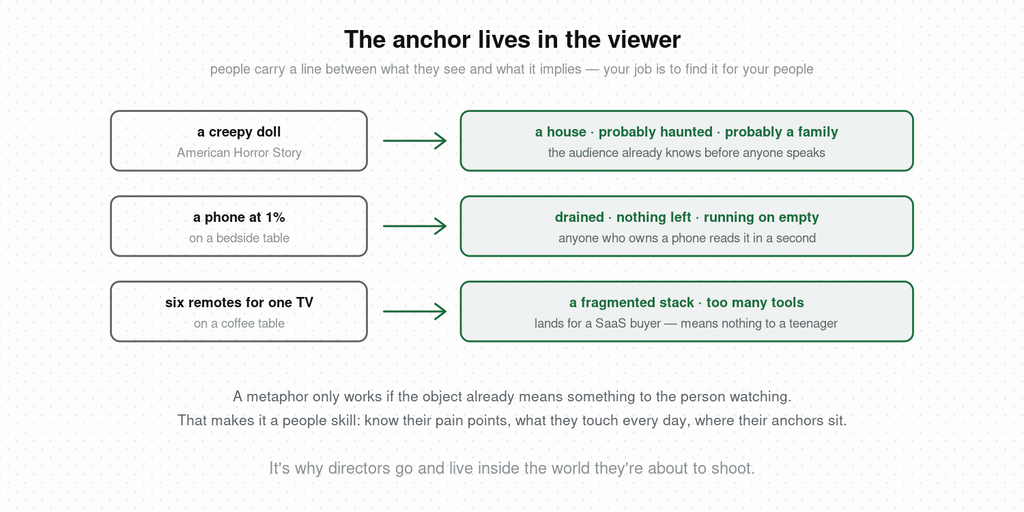
A metaphor only works if the object already means something to the person watching. That makes this a people skill more than a visual one: you need to know your audience’s pain points, what they touch every day, and which objects sit at the anchors of their lives. Stand where they stand and you can predict what a thing will set off in them.
It’s why directors go and live inside the world they’re about to shoot. You can’t build a convincing aristocrat’s room if you’ve never seen one, or stage an ordinary woman’s working life if you’ve never stood in it, because you don’t know which objects carry the weight. It runs the other way too: put a creepy doll in frame — American Horror Story does this — and the audience already knows we’re in a house, probably haunted, probably a family. People carry a line between what they see and what it implies. Your job is to find that line for your people, and it’s found by looking at their lives.
Two metaphors in one video. Two decodings in thirty seconds is a puzzle. One image, one idea.
An image that needs explaining. If the caption has to say what the metaphor means, it failed. Test it on someone who hasn’t heard the point; if they can’t guess in two seconds, pick a plainer object.
Too clever. The best visual metaphors are slightly obvious. Cleverness delays recognition (the same trap vivid imagery falls into when it gets ornate); delay is a swipe.
Knowledge and education. Every abstraction has an object waiting for it. Compound interest is a snowball on a hill. Cognitive load is sixty open tabs. Open on the object, and the explanation has something to stand on.
B2B and SaaS. The pain point is the metaphor. Manual reporting is someone copying one spreadsheet into another by hand. A fragmented stack is six remotes for one TV. Show it before the product, and the product becomes the transformation.
UGC and product. The benefit as an object beats the benefit as a sentence. “Saves time” is a sand timer; show the sand stop. “Lasts” is the product next to the three cheaper ones it outlived.
Faceless accounts. The metaphor is your B-roll, and needs no face or voice. A document-frame vlog built on one strong image per video is a channel you can batch.
What is a visual metaphor?
A visual metaphor is an image used to represent an idea, so the viewer understands the idea by recognising what the image stands for. The idea is the tenor, the image is the vehicle, and the viewer supplies the connection between them.
What are visual metaphor examples in film?
Captain Willard’s face superimposed over burning jungle in Apocalypse Now shows a man merged with the war. The staircase in Psycho stands for dread. In advertising, BMW’s large dog with a tiny food bowl stood for “more power, less consumption.”
What’s the difference between a visual metaphor and symbolism?
A symbol is a fixed sign with an agreed meaning, like a dove for peace. A visual metaphor is a fresh comparison the viewer has to work out — this thing is like that thing — which is why it lands with more force than a symbol.
How do you create a visual metaphor?
Reduce your point to one clean claim, then find an object that already means that claim to most people: a dying battery for exhaustion, sixty open tabs for overload. Put the object in frame with one line of text naming the idea, and test it on someone who hasn’t heard the point.
How are visual metaphors used in advertising?
Ads use them to make a product claim without stating it — a comparison, a stand-in object, or a transformation that the product causes. The viewer decodes the image and feels they reached the conclusion themselves, which is more persuasive than being told.
Do visual metaphors work in short-form video?
They may work better there than anywhere, because most viewers have the sound off and decide within a second. One image that carries the idea, with a single line of text on top, is a complete hook that needs no narration.
The point you couldn’t say in three sentences is usually one object you haven’t found yet. Hookova breaks any saved Short down second by second so you can see which image the videos in your niche chose. For the full range of opening techniques it recognizes, see the video hooks guide.
 Hookova