Most Instagram bio ideas come as lists of lines to copy, and a copied line can read well while still leaving the bio’s main job undone. In 150 characters a bio has to tell two very different readers who you are, and only you know the answer.
The first reader is Instagram itself. The platform builds a picture of every account from what’s on it, the profile text included, and uses that picture to decide which people your posts get shown to. The second reader is a person who just watched one of your posts, tapped your name, and is deciding in about two seconds whether to follow. This guide is about writing for both, with the bios of seven large accounts as the evidence.
I’ve helped a lot of people tune their bios, and the lessons that stuck came from testing on my own account. That’s where everything below comes from.
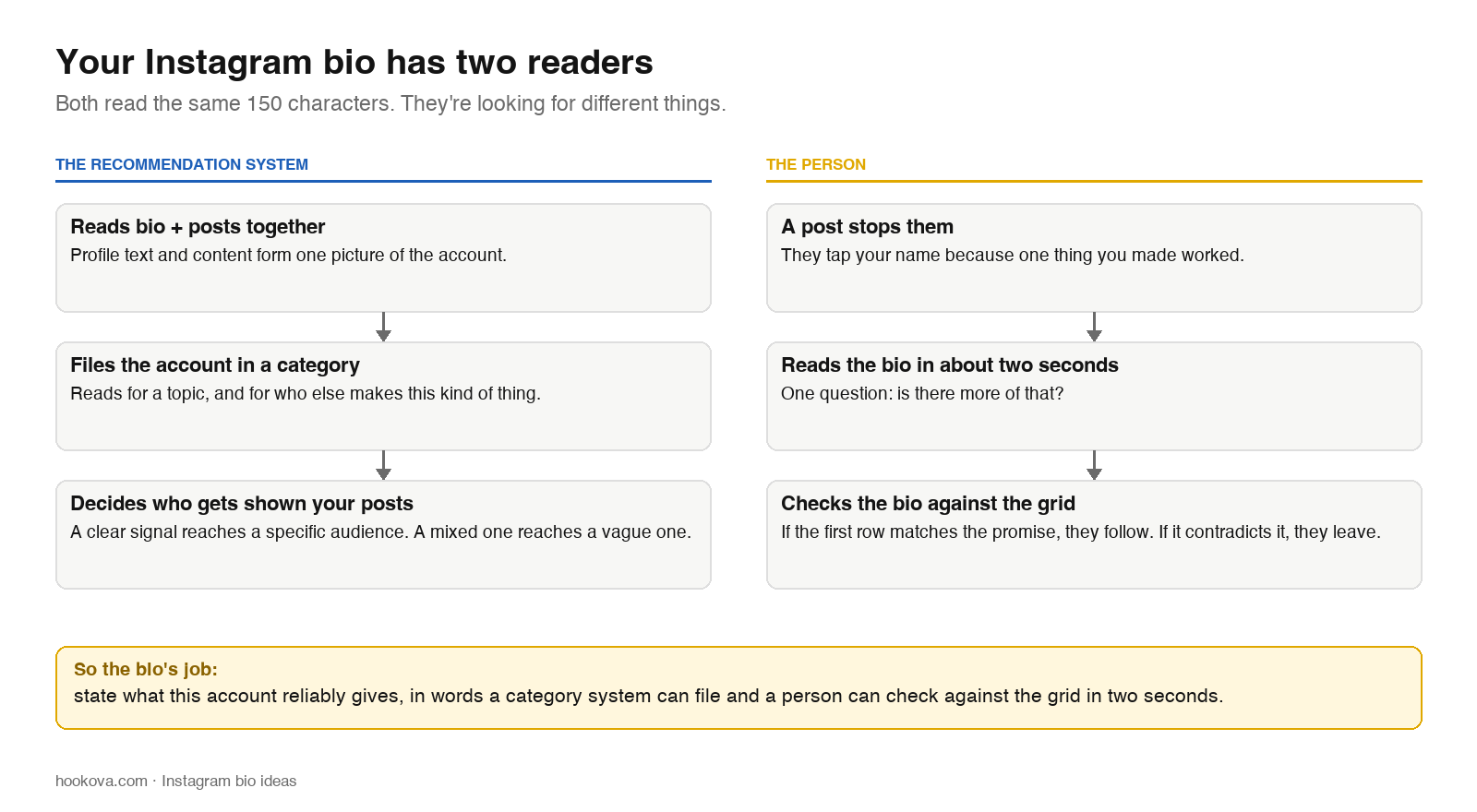
The recommendation system reads your bio alongside your posts to work out what your account is about and who might want it. It reads for a category. An account whose bio says one thing and whose posts say another sends a mixed signal, and a mixed signal gets shown to a vaguer audience. Instagram’s own guidance to creators is that profile and content together tell it who you are, and the bio is the one place you get to say it in your own words.
The person arrives in a specific state: something you posted stopped them. They’re on your profile to answer one question, *is there more of that?* They read your bio in about the time it takes to glance at the first row of your grid, and they’re checking whether the two match. A bio that promises daily recipes above a grid of four posts from last spring is usually the moment they leave.
So the bio’s job comes down to this: state what this account reliably gives, in words a category system can file and a person can check against the grid in two seconds.
I pulled the bios of seven accounts with between 600,000 and 91 million followers. Three patterns, and the pattern an account uses tells you how much work its bio is being asked to do.
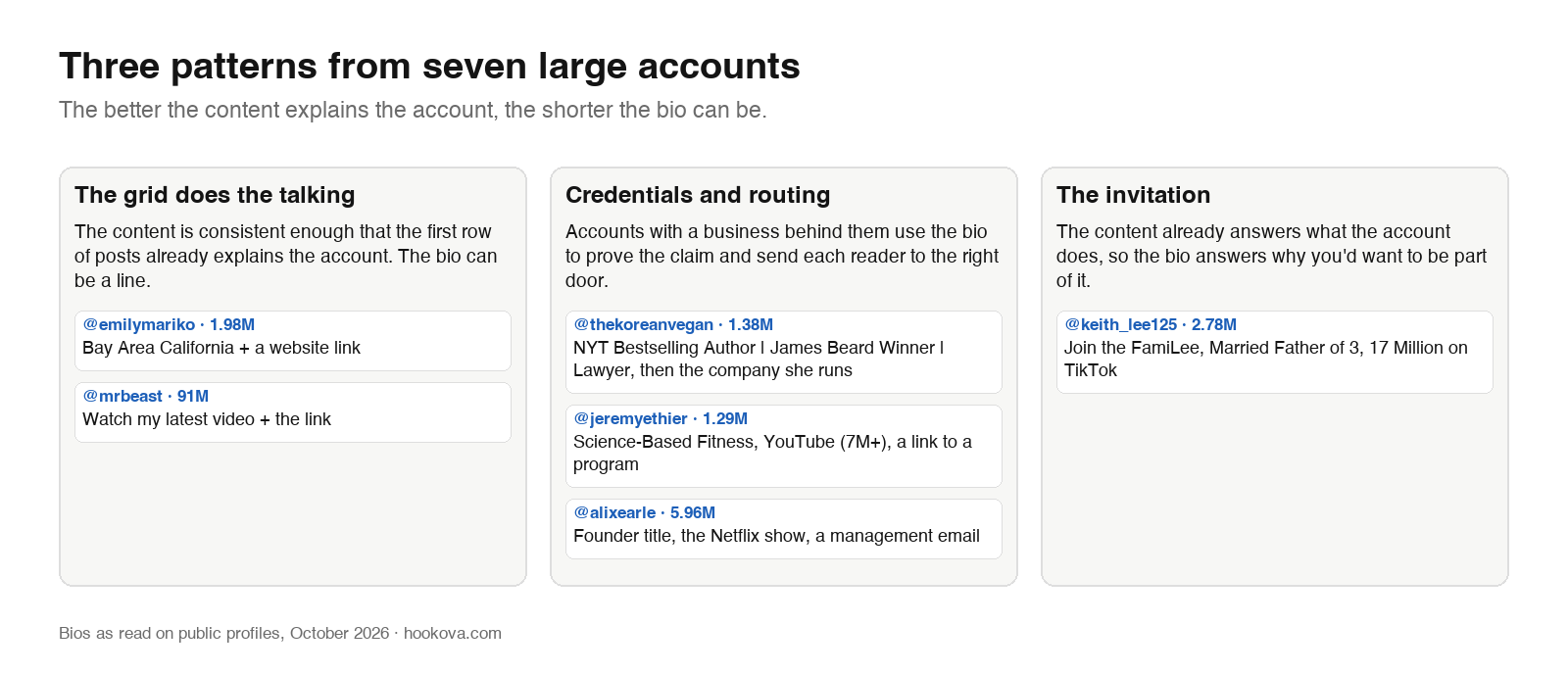
The grid does the talking. Emily Mariko, with nearly two million followers, has a bio that reads “Bay Area California ☀️” and a link. MrBeast’s is a single line pointing at his latest video. These bios say almost nothing because the content is so consistent that the first row of the grid already works as one. It’s the pattern most people copy, and it only works once the grid can explain the account on its own. Before that, a one-line bio leaves both readers guessing.
Credentials and routing. Joanne Molinaro, posting as The Korean Vegan, uses her name field for her name in English and Korean, and her bio for “NYT Bestselling Author | James Beard Winner | Lawyer” plus the company she runs. Jeremy Ethier’s name field includes his kinesiology degree; his bio says “Science-Based Fitness,” cites his YouTube audience, and points at a program. Alix Earle’s leads with her company title and her Netflix show, then a management email. Tinx’s does the same with her book and her radio slot. These are accounts with a business behind them, and the bio is doing two jobs at once: proving the claim and routing the right reader, whether that’s a fan, a brand or a press contact, to the right door.
The invitation. Keith Lee’s bio opens with “Join the FamiLee,” then “Married Father of 3,” then his TikTok audience. It describes what you’d be joining, and leaves what he does to the content, which already answers that. The bio is free to answer why someone would want to be part of it.
What the three have in common: the better the content explains the account, the shorter the bio can be. A new account, or one changing direction, needs the credentials-and-routing pattern even without credentials, because the promise has to be stated in plain words until the grid can make it.
Most weak bios start from the question *what should I say about myself?* The strong ones I’ve seen start from *who do I want to tap follow, and what do they need to believe first?*
Answer four things before writing a word:
Those four answers are your bio. The order on the page is usually the order above, because line one is what shows in search and in the suggested-accounts card.
The same four questions give different bios depending on who’s reading, which is the gap in “bio ideas by account type” lists: they sort by what you are, when the useful sort is who you’re writing for.
If you’re a creator building an audience, the reader is someone who came from a post. They already like one thing you made; the bio has to confirm there’s a pattern. Describing yourself (“content creator, coffee lover”) leaves the pattern unstated; “one-pan dinners, Tuesdays” states it. Your personality belongs in the bio, but in one line, after the promise.
If you’re a UGC creator, the reader is a brand manager or an agency producer scanning twenty profiles in ten minutes, and they’re reading for three things in order: what kind of product you shoot, what your footage looks like, and how to book you. That changes what matters. Your niche is a product category here, because that’s the filter they’re applying. Your proof is the portfolio the link opens, so the bio’s job is to get them there without friction, which means a turnaround time or a brand count beats any adjective. And the type of UGC creator you are changes the first line: an on-camera creator leads with the category and themselves; a faceless product creator leads with the product category and the format; a local creator leads with the city, because that’s what the brand is filtering by. Why views don’t turn into sales is the question brands bring, and the portfolio page is where to answer it.
If you’re a small business, the reader wants what, where, and how to buy, and they want it before they scroll. Hours and address go in the contact buttons, which frees the bio. The one line of personality is worth keeping, because it’s the difference between a listing and a place.
If it’s a personal account, the reader is someone deciding whether you’re interesting, and the bio can drop the ask entirely. Keep the specifics; “slow mornings, film cameras, too many notebooks” tells a stranger more than “living my best life” ever will.
The name field, the bold line under your photo, is searchable. The bio text is not. Instagram search matches usernames and names, so an account whose name field says only “Maya” is invisible to anyone searching *weeknight recipes*, while “Maya · Weeknight Recipes” shows up. The Korean Vegan and Jeremy Ethier both use the name field this way, for a second name and a credential respectively. Put the topic there, keep the bio for the human part, and you’ve doubled the space you had.
Two mechanical notes while you’re there. Line breaks work if you type them in the app on your phone. Styled text from a font generator pastes into both fields, but it’s unreadable to search and to screen readers, so use it for one word at most.
A bio is the only part of your account you can change in thirty seconds and measure in two weeks. Instagram’s insights show profile visits and follows; the ratio between them is your bio’s conversion rate. Change one thing, wait two weeks, compare.
My own bio is one positioning line, “Work-life balance aesthetics,” and a location. It got there by elimination. Across the accounts I’ve worked on, the change that moved profile visits the most was making the bio match what the last three posts were. A cleverer line rarely did. When the grid shifted, the bio had to shift with it, or the mismatch cost follows.
A bio generator works as a draft partner, and what you feed it decides how useful the drafts are. Give it the four answers above, who it’s for, what they get, what makes it believable, the one ask, and the Instagram bio generator will return eight bios inside the 150-character limit, each taking a different angle on the same answers, with the count shown under each. Pick the angle, then rewrite it in your own words. If the username doesn’t match the bio yet, the username generator works from the same one-sentence description and explains what each handle signals.
The same discipline applies to captions: the caption generator should write in the voice the bio set. Content inspiration as a system is how you keep the grid delivering what the bio promised.
How long can an Instagram bio be?
150 characters, including spaces, emoji and line breaks. The name field is separate and allows 64 characters, and it’s the one that search reads.
Is the Instagram bio searchable?
No. Search matches the username and the name field. Put your topic in the name field and keep the bio for the promise and the ask.
Can I put a link in my Instagram bio?
Yes, in the dedicated link field, which holds up to five. Text in the bio itself can’t be tapped, so the last line of the bio points down at the link.
How often should I change my bio?
When the account changes. A schedule has nothing to do with it. The only line that goes stale on its own is the ask, because the thing in the link changes.
Should a new account copy a big creator’s minimal bio?
No. A one-line bio works when the grid already explains the account. A new account needs to state the promise in words, because its content can’t make the case yet.
A bio earns a visit; the first three seconds of your latest post decide whether the visit becomes a follow. Paste any Reel into the Hookova analyzer and see, shot by shot, what the opening is doing, then make yours do the same.
 Hookova