You watched two hundred videos today. Somewhere in there were six you’d have made yourself, and by the time you sat down to film, all six were gone and your head was full of noise. Then you searched for content inspiration and got a list: watch trends, study competitors, check Pinterest, follow the big accounts. Watch more.
That’s the advice that put you here. Inspiration for a short-form creator is a supply problem in the same way a leaking bucket is: adding water isn’t the fix.
Content inspiration is the raw material that turns into a video — a moment, a format, a line, a feeling — and it only counts if it’s still available to you when you sit down to make something. A spark you can’t find again a day later was a distraction you had once.
The lists get one thing right: other people’s videos are a real source. What they miss is that the source was never the bottleneck. Almost every creator I know has more input than they can use. The gap is between watching and making, and that gap is where the system goes.
I run inspiration as five fixed stages: collect, organize, pick, make, schedule. Every creator does the fourth one. Most do the first one badly and skip the second and third entirely, which is why the fifth never gets a chance.
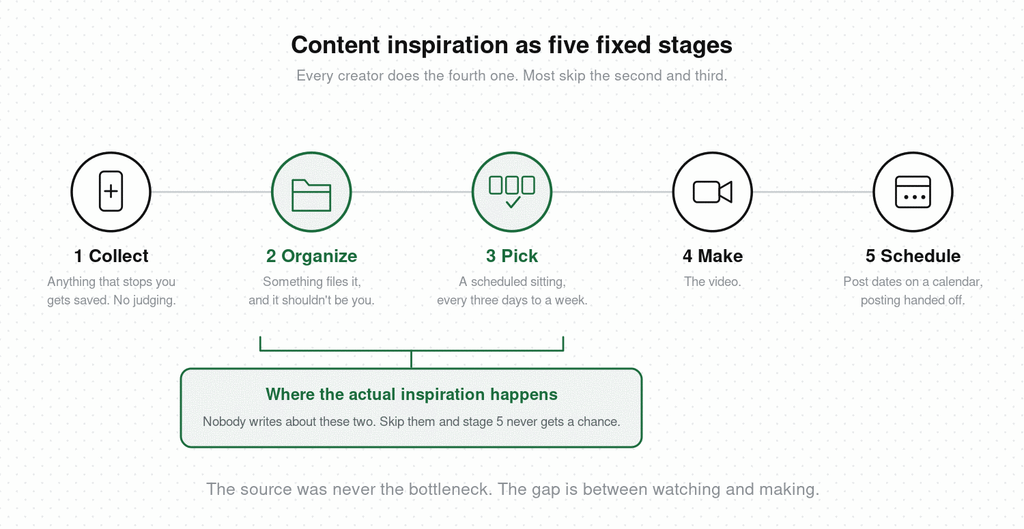
Collect. Anything that stops you gets saved. The bar is it made me pause, and nothing else — no judging, no “is this my niche,” no notes. Judging while collecting is the thing that turns a two-second save into a five-minute detour.
Organize. Someone or something files it, and it shouldn’t be you. A camera roll of screenshots is where ideas go to die a second time; a folder of links you’ll never reopen is the same grave with a different name.
Pick. A separate sitting, on a schedule, where you open what you collected and choose. This stage is the one nobody writes about, and it’s where the actual inspiration happens.
Make. The video.
Schedule. Post dates on a calendar, and the posting itself handed to a scheduler so the making and the publishing stop competing for the same evening.
Here’s the part that runs against every list. Watching more short video made me worse at coming up with ideas. Past a certain point the feed is overload: a hundred formats blur into one, and my own observations get drowned out by everyone else’s. The new ideas came from stepping away from the phone — from daily life, from what happened on the walk, from the thing a friend said at dinner.
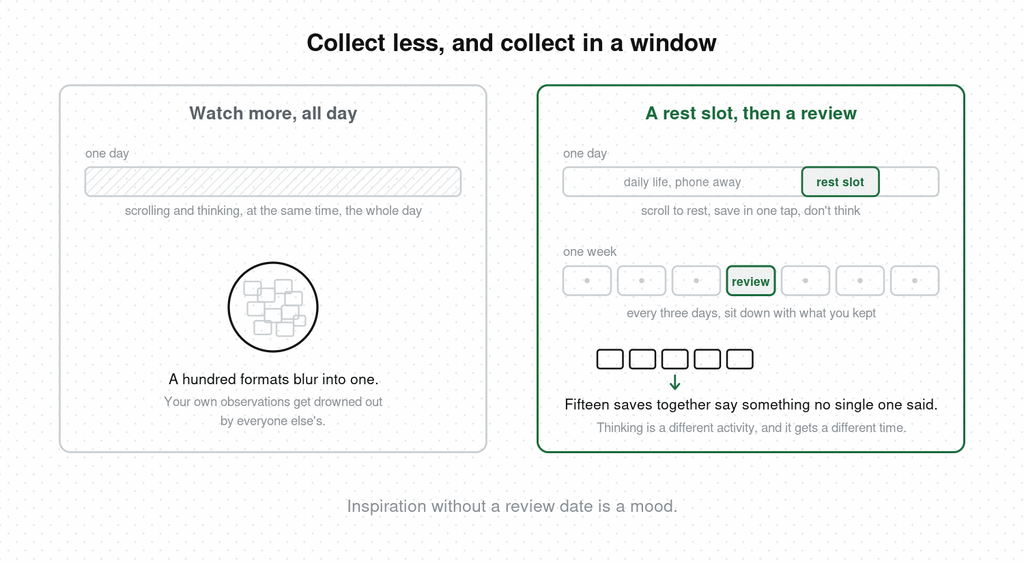
So I split collecting into a window. There’s a rest slot in the day that’s for scrolling, and it’s honestly for resting. I don’t think during it. When something good goes past, it gets saved and I keep scrolling. Thinking is a different activity, and it gets a different time.
That save has to be one motion or the window stops being rest. Hookova is the tool I use for this: install the extension, and a single tap on any TikTok, Reel, or Short files it into your library, sorted into a broad category automatically. Nothing to name, nothing to tag, nothing to decide. The thinking waits for the review.
Every three days, a week at most, I sit down with the library. This is the pick stage, and it has its own rules: it’s scheduled, it’s unhurried, and it’s the only time I look at saves with the intention of making something.
I open a new project in Hookova, drag in the saves that are pulling at me, and let it work through them as raw material. Three things come out of that sitting, and they’re the reason the stage exists.
First, the pattern. Fifteen saves on a screen together say something no single one said. Eleven of them open the same way, or nine are the same feeling in different clothes. That’s an observation that was already in my head, unspoken, and now it has a name. Sometimes something new emerges from the batch — an angle that isn’t in any of the saves, that only appears when they’re side by side.
Second, the decision. With a pattern in front of you, the question from every vlog I’ve shot is easy to ask: what am I trying to say? Three videos come out of the sitting with an answer to that; ten more go back into the library for another week.
Third, the fresh idea. If something new occurs to me during the review, it goes straight into the project alongside the saves. The review is the one time input and my own thinking are in the same room, on purpose.
Inspiration without a review date is a mood. You wait for it, and when it doesn’t arrive you read another list of twelve sources. A review every three days makes the feeling irrelevant: the sitting happens whether you’re inspired or not, and the library is full whether you remember why or not. That’s also the difference between this and a data tool that tells you what’s trending: the library is what stopped you, so what comes out of it is yours.
If you’re currently blank, the sister piece on creative block covers the one-hour fix. This article is what you run after that, so it doesn’t come back.
Personal brand and lifestyle. Your best inspiration is off the phone. Keep the rest window short, then look at your day for the video — the review turns “nothing happened” into a frame you’ve already seen work.
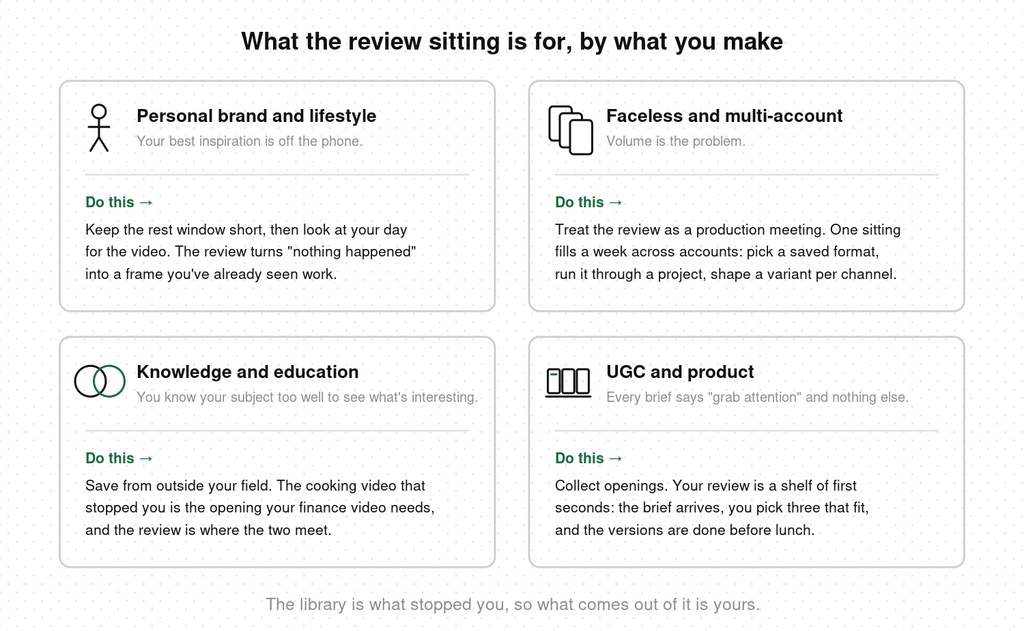
Faceless and multi-account. Volume is the problem, so the review is a production meeting. One sitting fills a week across accounts: pick a saved format, run it through a project, and the variants come out shaped for each channel.
Knowledge and education. Save from outside your field. The cooking video that stopped you is the opening your finance video needs, and the review is where the two meet.
UGC and product. Collect openings. Your review is a shelf of first seconds; the brief arrives, you pick three that fit, and the versions are done before lunch.
Where do content creators get inspiration?
Mostly from other creators’ videos, and from their own daily lives. The ones who stay consistent don’t rely on remembering either: they save what stops them the moment it happens and review the saves on a fixed schedule.
How do you find content inspiration when you feel stuck?
Stop searching for more and open what you already saved. A library of things that stopped you over the past week is a list of videos you want to make. If it’s empty, spend three days saving with no judgment, then review.
How do you organize content ideas?
Let a tool do it. Saving into a library that categorizes automatically keeps the collecting step to one tap, and the organizing happens without you. Manual folders and notes apps work until the day you stop maintaining them, which is usually day four.
What’s the difference between content inspiration and content ideas?
An idea is a specific video you could make. Inspiration is the raw material an idea comes from — a saved video, a moment, a line — and it usually needs a review sitting to become an idea. Most lists of “content ideas” are really lists of subjects.
How often should you plan content?
Every three days to a week for the review, where saved material becomes decided videos. Longer than a week and the saves go cold; shorter and there isn’t enough in the library to see a pattern.
Where does content inspiration come from for faceless accounts?
From saved formats. A faceless account runs on structure — the way a video opens, the pacing, the text-and-footage relationship — and those are all things you can save from any niche and reuse on your own footage.
The videos you’ll make next month are going past you this week. Save them in one tap, let them file themselves, and sit down with them on Thursday. Hookova holds the library and, when you’re ready, breaks down the ones you choose second by second. For the full range of opening techniques it recognizes, see the video hooks guide.
 Hookova