You sit down to make a video and there’s nothing. Blank. And yet yesterday, scrolling, at least five things stopped you cold and you thought I could do something with that. They’re gone. You couldn’t name one of them now.
That’s the shape of creative block for most short-form creators, and it’s why the standard advice — take a break, change your environment, go for a walk — doesn’t fix it. You weren’t out of ideas. Twenty ideas a day were arriving, and none of them were being kept.
Creative block is the gap between the input you take in and the output you can produce from it. Painters and novelists get the empty kind: nothing comes in, nothing goes out. Short-form creators mostly get the flooded kind: hundreds of videos a day come in, almost nothing is retained, and the sheer volume makes each individual spark unrecoverable an hour later.
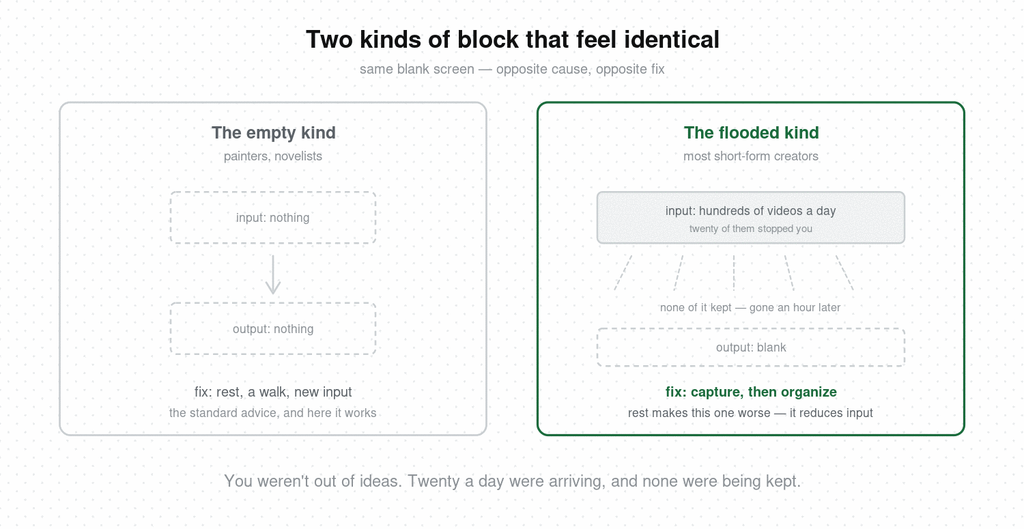
The feeling is identical — sitting in front of the camera with nothing — but the cause is the opposite, which is why rest makes it worse. Rest reduces input. Your problem was never input.
There’s a second cause underneath, and it’s the one that survives even when capture is fixed: you haven’t decided what you’re trying to say. With no frame, every idea is equally valid and none is usable. That’s decision paralysis wearing creative block’s clothes.
Do this today. It’s mechanical and it works.
Turn scrolling into capture. For the rest of the week, every time a video stops you — any platform, any reason — save it. Don’t judge whether it’s “for you.” The bar is that it made you pause. You’ll save fifteen to thirty a day and it costs nothing.
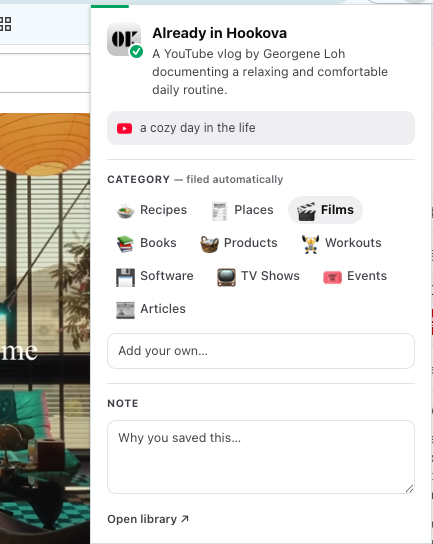
Let something organize it. A camera roll of screenshots is where ideas go to die a second time. Hookova is built for this exact leak: the extension saves any TikTok, Reel, or Short in one click, and the library sorts itself into broad categories so nothing lands in a pile. What surfaces is the pattern in your choices — you scroll your saves and find eleven that all open the same way, and an observation that was already in your head, unsaid, has a name. When you’re ready, analyze any one of them and it comes back broken down second by second; or drop the saves you want to borrow from into a project, and Hookova generates content shaped for you from exactly that raw material. That’s a base station for your own attention, and it’s the opposite of blank.
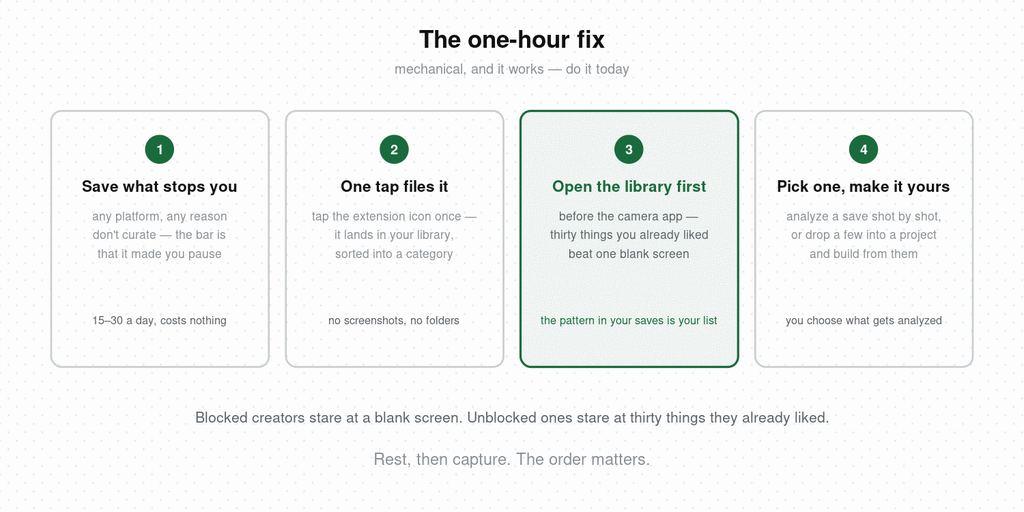
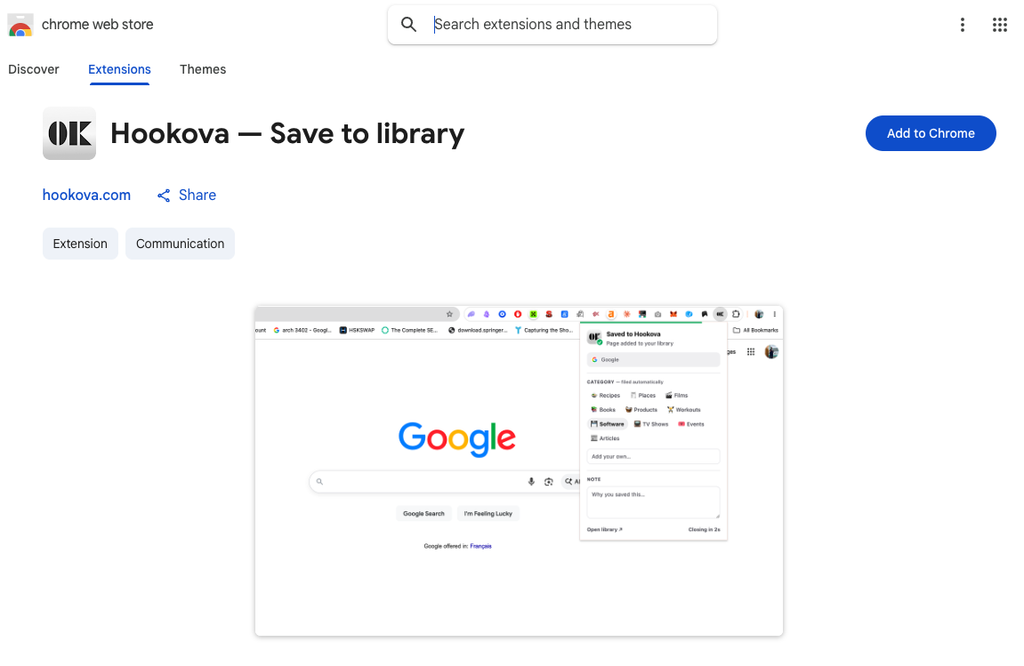
Set it up in two minutes. Add the Hookova extension from the Chrome Web Store and sign in. From then on, whenever a TikTok, Reel, Short, or any page stops you, tap the extension icon once — it files the save automatically, and a few seconds later it’s waiting at hookova.com/saves. Open the library whenever you want, pick a save to analyze, or start a project and drop in the ones you want to borrow from.
Open the library before the camera. The next time you feel blocked, open the saves before you open the camera app. Blocked creators stare at a blank screen; unblocked ones stare at thirty things they already liked and pick one to make theirs.
There’s a third kind of block, and it hits people who are actually good. Ira Glass called it the taste gap: your taste has developed faster than your ability, so everything you make disappoints you, and eventually you stop making things. It feels like having no ideas. It’s having ideas your hands can’t yet execute.
The library helps here too, in a way a walk can’t. Your saves are your taste, made visible and specific. Run the one-week test: save without curating, then read the breakdowns side by side. When the same opening, pacing, or text-and-footage relationship keeps showing up, you’ve found what your taste actually wants — and a specific thing to practise is a much smaller problem than a vague sense that nothing’s good enough.
Capture fixes the flooded kind. The decision kind needs one question, asked before anything else: what am I trying to say?
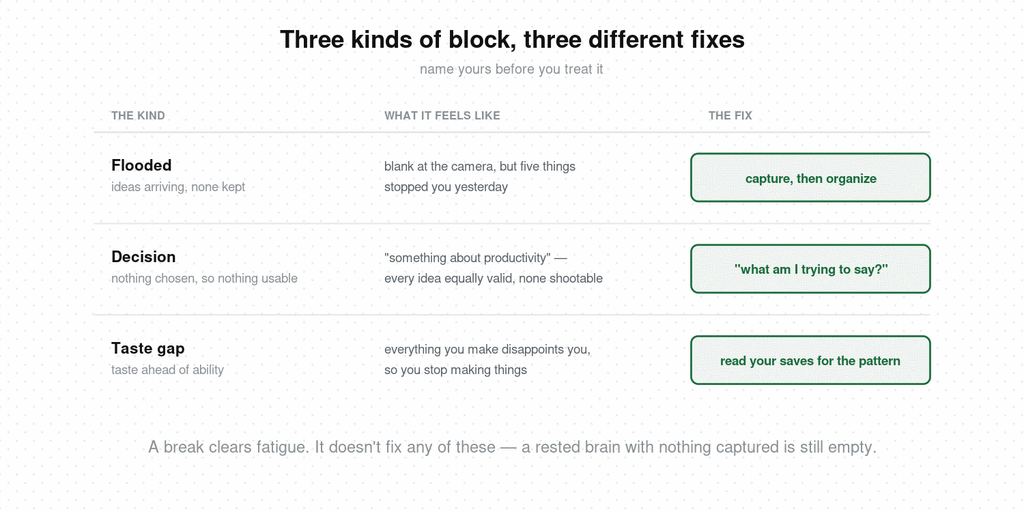
Vague answers produce block. “Something about productivity” gives you nothing to shoot. “People confuse being busy with being useful” gives you a visual metaphor (a full calendar next to an empty to-do list), a frame (“day 3 of doing less”), and an ending. The block wasn’t a shortage of ideas; it was one undecided sentence blocking all of them.
Run the question on your saves. Every video you kept was making a point. Name it in one line. The ones you can’t name go; the ones you can are the videos you actually want to make, and you now have a list.
Every new account I’ve run gets the same first three months: post daily, and quality is explicitly off the table. That rule exists for camera comfort, but it does something for block too. Waiting to feel inspired is how a two-day gap becomes a two-month one. A daily post at 60% quality keeps the input–output loop running, and the loop is what produces the next good idea. Inspiration is downstream of output far more often than the other way round.
The walk, the break, the change of scenery — none of it is wrong. It’s incomplete. A break clears fatigue, and fatigue is real. But you’ll come back to the same blank screen if the leak is still there, because a rested brain with nothing captured is still empty. Rest, then capture. The order matters.
Personal brand and lifestyle. Your block is usually the decision kind — the day happened, nothing felt like a video. The morning question and a series frame (“day N of”) turn the day into one before you’ve shot anything.
Faceless and multi-account. Your block is volume: five accounts, daily output, and the well runs dry. The library is your production system. One saved format, ten variants, and the week is filled from something you already liked.
Knowledge and education. You know your subject too well to see what’s interesting about it. Saves from outside your niche fix this — the hook that stopped you in a cooking video is the hook your finance video needs.
Skits and comedy. Premise lists don’t cure this one; timing does. Save the videos that made you laugh, rewatch three of them before writing, and the rhythm comes back before the idea does.
What is creative block?
Creative block is the inability to produce new work despite wanting to. For content creators it’s usually a gap between input and output: plenty of material is coming in, but none of it is captured or decided on, so nothing usable comes out.
What’s the difference between creative block and writer’s block?
Writer’s block is the specific version for writing; creative block covers any medium. For short-form creators, the difference matters less than the type: the “empty” kind needs new input, the “flooded” kind needs capture and a decision.
How long does creative block last?
As long as the cause does. Fatigue-based block clears with rest in days. Capture-based block clears within a week of saving and organizing what stops you. Decision-based block clears the moment you can say what the video is trying to say.
Is creative block normal?
Yes, and for creators posting daily it’s close to inevitable. The mistake is treating it as a mood to wait out. It’s more often a system problem — ideas arriving and leaking — and systems can be fixed.
How do you get ideas for short videos?
Save everything that stops you for a week, let it organize, then look for what repeats. The pattern in your own saves is a list of videos you want to make. Add one question before shooting — what am I trying to say — and most of the list becomes shootable.
How do content creators deal with creative block?
The ones who post consistently have a capture habit and a frame for each video. Ideas are saved the moment they land, never trusted to memory, and every video answers a single question before filming starts. The advice to rest is right, but it comes second.
The ideas you can’t find tonight went past you yesterday. Catch them, let them organize, and blank stops being the default. Hookova saves any TikTok, Reel, or Short in one click and breaks it down second by second, so the library you build is one you can actually make videos from. For the full range of opening techniques it recognizes, see the video hooks guide.
 Hookova