You run the research, the tool drafts the script, the title and tags are optimized, and the video you make is competent and completely interchangeable with the other forty videos on that topic this month.
If that’s the itch that brought you here, the fix is a different kind of tool. And it’s worth being precise about which kind, because vidIQ does its actual job well.
I spent time inside vidIQ recently — the full review is here —, and the delivery flow deserves the reputation. It leans toward mid-length and long-form YouTube. The script and SEO flow is genuinely clean — it moves you forward by asking questions, each answer feeding the next step, so you go from topic to outline to optimized package without staring at a blank page. Outlier scores and views-per-hour surface what’s over-performing in your niche while it’s still climbing.
If your channel lives on search traffic — tutorials, reviews, how-tos where ranking for a query is the whole game — that workflow earns its subscription, and nothing below argues otherwise.
The problem showed up when I read what it wrote. I had it generate a script, and the result was nearly identical to what most creators in that niche were already saying. Same beats, same framing, same conclusions.
That’s the mechanism working as designed. A tool that starts from platform data can only hand you what the platform already rewards. The research pool is what’s currently winning, so the output converges on what’s currently winning. Everyone using it stands in the same pool. You can execute faster than the crowd, but you can’t sound different from it, because nothing in the input is yours — the only personal signal it can read is your own channel, which for a small or new channel is barely a signal at all.
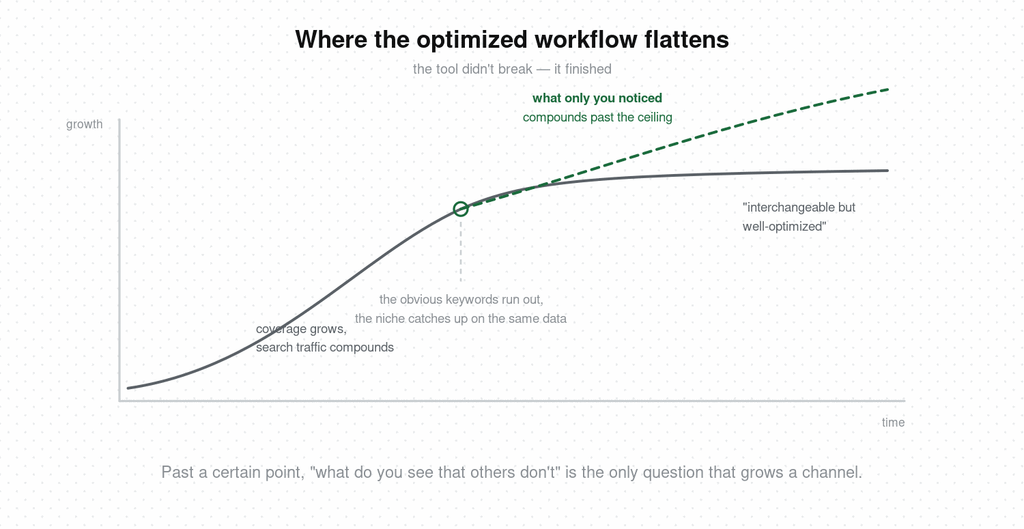
Trend data answers what is working. It has no way to answer what do you see that others don’t — and past a certain point, that second question is the only one that grows a channel.
You can watch this ceiling arrive in a channel’s own numbers. The first months of an optimized workflow feel great: coverage grows, search traffic compounds, every video is competently packaged. Then the obvious keywords run out, the niche’s other channels catch up on the same data, and growth flattens at whatever level “interchangeable but well-optimized” earns in that niche. The tool didn’t break. It finished.
The material that makes you different already passes through your hands every day: the videos you stop on, save, and think about. That reaction is your taste — the one input no shared data pool contains. It just evaporates, because nobody organizes it.
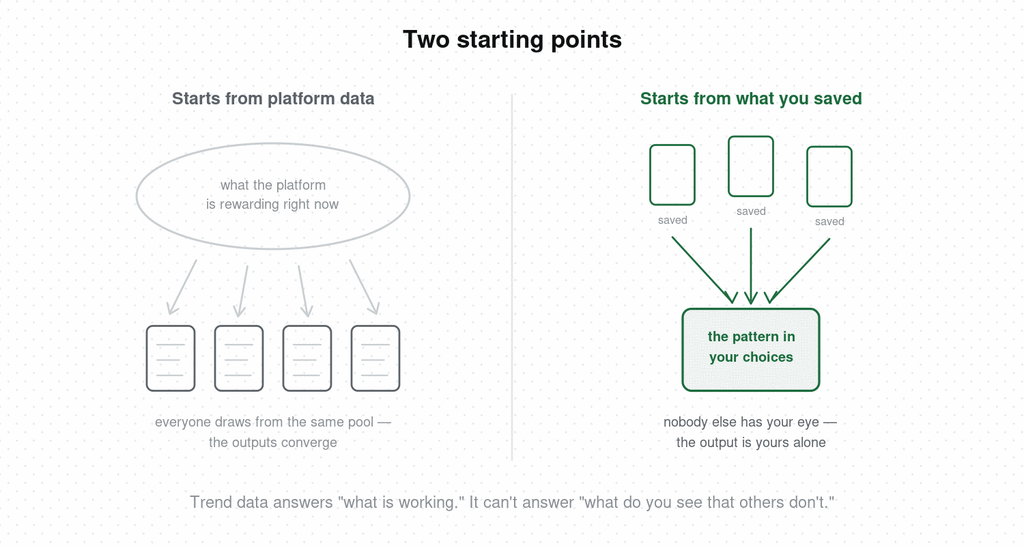
Hookova is built on that input. It works less like an analytics dashboard and more like a base station for your own head: save any TikTok, Reel, or Short in one click with the extension and it lands in a library that sorts itself into broad categories. From there you choose: analyze any save and it comes back broken down second by second, or drop the ones you want to borrow from into a project, and Hookova generates content shaped for you from exactly that raw material.
What surfaces over time is the pattern in your choices. You open the library and find you’ve saved eleven videos that all hold a static shot two beats longer than feels safe — an observation that was already in your head, unsaid. Named, it becomes a creative asset nobody else can have, because nobody else has your eye. That’s what keeps the work real: it comes from a person with a point of view, and audiences can tell.
| vidIQ | Hookova | |
|---|---|---|
| Starts from | Platform trend data | Videos you chose to save |
| Best for | Long-form YouTube, search traffic | Short-form across TikTok, IG, YouTube |
| Script output | Fast, optimized, sounds like the niche | Generated from the saves you drop into a project — shaped by your taste |
| Keyword & SEO research | Yes, core feature | No |
| What compounds over time | Your ranking coverage | Your personal reference library |
| The risk | Sounding like everyone using it | Requires actually saving as you scroll |
Two different jobs. If yours is ranking, stay where you are. If yours is developing a voice — or your growth stalled once you’d covered the obvious keywords — the missing tool is the library.
You don’t have to take a position on any of this to find out which tool you’re missing. Run the week you were already going to have, with one change.
Every time a video stops you — any platform, any length — save it. Don’t curate, don’t overthink, don’t decide in the moment whether it’s “useful.” The bar is only that it made you pause. At the end of the week, open the library and read the breakdowns side by side.
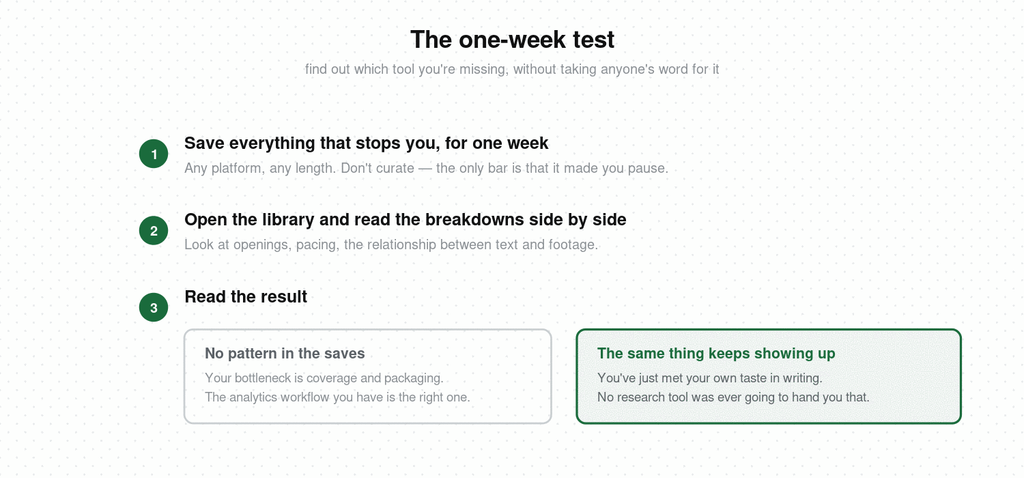
If the saves are all over the place with no pattern, your bottleneck probably is coverage and packaging, and the analytics workflow you already have is the right one. If a pattern jumps out — the same kind of opening, the same pacing, the same relationship between text and footage showing up again and again — you’ve just met your own taste in writing, and no research tool was ever going to hand you that.
You’re a knowledge or education channel. Your topic list overlaps with hundreds of channels, so delivery is the only differentiator left. A library of saved openings shows you which framing devices you’re drawn to; that’s your voice, already formed, waiting to be noticed.
You’re building a personal brand. Sounding like yourself is the entire product. A script tool that averages the niche works directly against it, and a taste library works directly for it.
You run faceless or multi-account operations. You already collect references constantly; the library turns that from screenshots scattered across camera rolls into an organized system, and what converts is visible per format across accounts.
You’re mainly fighting the editing timeline. Different problem — that one’s covered in the CapCut alternatives piece.
Is vidIQ worth it?
For long-form YouTube channels built on search traffic, generally yes — the keyword research and guided script flow are efficient and well designed. It’s weakest as a differentiation tool, since its recommendations draw from the same trend pool as every other subscriber’s.
What’s the best vidIQ alternative?
It depends on the gap. For channel SEO, its direct analytics competitors cover similar ground. For developing original material and a recognisable style, a reference library tool like Hookova addresses what analytics platforms structurally can’t — input that’s yours alone.
Does vidIQ work for YouTube Shorts?
It has Shorts-related features, but its core workflow — keyword research, titles, tags, search optimization — is built around long-form discovery. Shorts distribution runs on completion and swipe behaviour, where search optimization matters far less than the hook.
Is there a free vidIQ alternative?
vidIQ itself has a free tier for basic stats. Hookova’s free plan includes saves and a set of analyses, which is enough to test whether the library workflow fits how you actually scroll and collect.
What about vidIQ vs TubeBuddy?
They compete head-to-head on YouTube optimization — bulk tools and A/B testing on the TubeBuddy side, research and AI flows on vidIQ’s. If your dissatisfaction is “the output sounds generic,” switching between them moves you sideways, because both start from the same platform data.
Can you use vidIQ and Hookova together?
Yes, and the pairing is coherent: vidIQ tells you what topics are worth making and how to package them for search, while your Hookova library tells you how to make yours different from the other results. The tools don’t overlap, because the inputs don’t.
Tools that read the platform will keep you current. The work that gets remembered comes from the observations only you have — and those need somewhere to accumulate. Hookova gives them a place: save what stops you, let the library connect it, and build from what it shows you about your own eye. For the full range of opening techniques it recognizes, see the video hooks guide.
 Hookova